

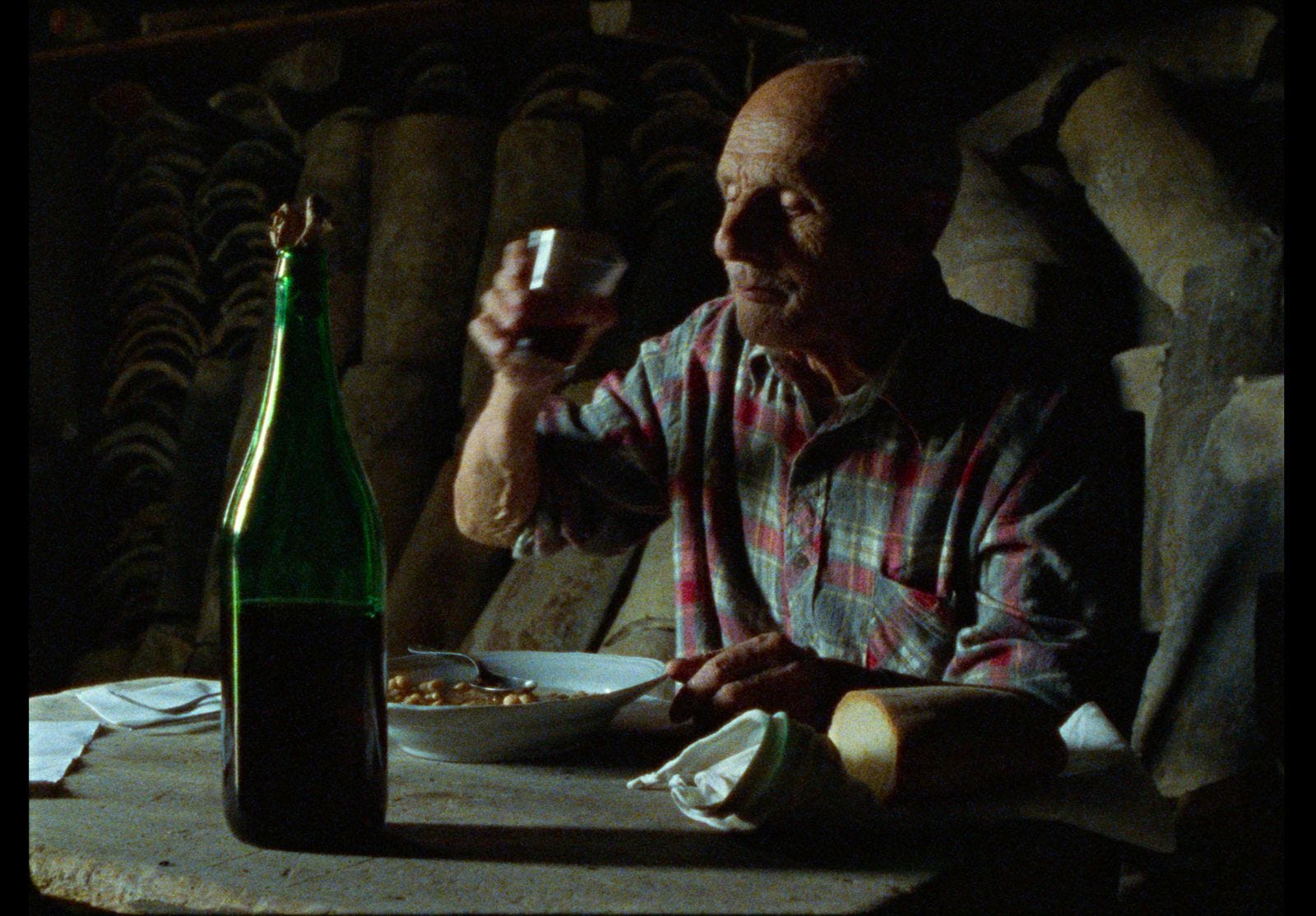
In the annals of unusual films, Italian director Michelangelo Frammartino’s “Il Dono” (“The Gift”) certainly earns a special place. An almost entirely silent observation unfolds over perhaps a week through the overlapping stories of an elderly man and a twenty something woman. In the old, semi-deserted mountainous village Caulonia in Calabria (southwest Italy’s bootheel region), daily existence for these two central characters proves increasingly sad and emotionally heartbreaking. Establishing this somber mood, in the opening scene the old man (never named) leaves his one room home to discover his dog ill, unresponsive. The man’s life and the dog don’t improve after that grim discovery.
More distressing, the young woman (also never named) must negotiate perilous mountain roads and cobblestone streets on her sole means of transportation, her bicycle. Repeatedly, male drivers find her resting, completely exhausted, all but in a trance. Individually, they stop, put her bicycle on top of or in their car, rape her, and then deliver her elsewhere. Her demeanor leads others to believe the devil possesses her, prompting one woman to perform an exorcising ritual. Interspersed, brief snapshots document the daily activities of the few other remaining villagers; in fact, a 1950s population of 15,000 now reduced to a couple hundred. Nevertheless, inhabitants quietly carry on: a blacksmith pounds iron on an anvil, a barber shaves the old man, a woman tends a store empty of customers, an elderly woman braids her hair, a boy chases a ball bouncing down concrete stairs into a narrow lane and off the cliffside into the ravine below.
A dog barks in nearly deserted streets, a church bell rings, a beached fishing boat leans into the sand on a beach with the young woman crouched in a corner, a herd of goats and several cats wander by as well as a funeral procession, while discarded car skeletons and metal scraps spoil the landscape. In effect, a sepulchral aura defines these and other daily events, the stunning beauty of the medieval town overwhelmed by the fading memory of past vibrancy.
In press notes Frammartino explains that he chose the title “Il Dono” (“The Gift”) as a tribute to noted French Algerian deconstructionist Jacques Derrida, one of the more challenging endorsers of metaphysical affects on all philosophy from phenomenology to ethico-political ideas. Frammartino thereby signals the breadth and depth of his stylistic decisions inspiring this deceptively simple yet multilayered, complex presentation of contemporary life. As the meaning of the title “The Gift” becomes clear, further contemplating this theoretical world adds sophisticated insights into human behavior, and yet viewers can also enjoy the film by merely luxuriating in the striking setting captured in varied, beautiful compositions. High angle shots of winding, valley roads and long shots of Caulonia’s narrow streets offer plenty of time for meditating on all life’s challenges, those found in a quiet, isolated village or a noisy, crowded city.
The acting by all involved in wordless performances reinforces the once stately but now exhausted look of the town. Director Frammartino’s grandfather Angelo as the old man impressively communicates a worn-out, shattered presence. As the young woman, Gabriella Maiolo conveys the enervating pain of the sexual exploitation she suffers through her traumatized demeanor and her frightened appearance. Though a world away from today’s demands and interactions, “Il Dono” (“The Gift”) communicates eloquently in a mesmerizing presentation. In a new 4K restoration, in Italian and purposely without subtitles, “Il Dono” screens at Webster University’s Winifred Moore auditoriumone night only, Thursday, August 28, at 7:30 p.m. that evening. For more information, visit the film series website.