

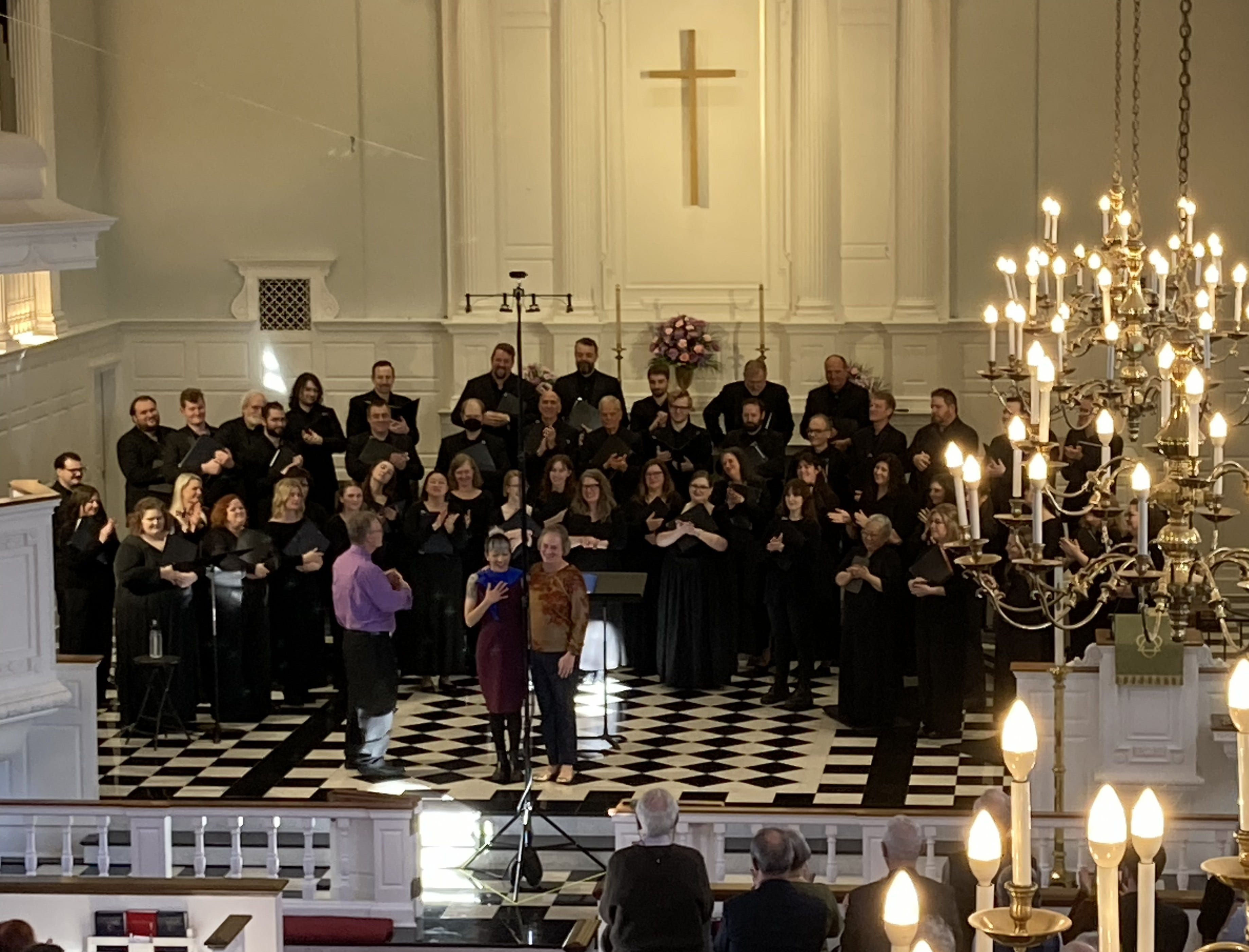
This past Sunday (February 15), the Saint Louis Chamber Chorus (SLCC) and its artistic director Philip Barnes gave its most recent concert at Salem United Methodist Church in Frontenac, on a bright, sunny, and unseasonably warm day to an audience of ~160-170. The concert’s theme was “Justice”, with selections from a diverse range of 12 composers (plus one popular music band), focused mainly on the 20th century. However, the program featured a substantial nod to the 21st century, with a world premiere with the composer present. Besides the world premiere, eight works on the concert were new additions to the SLCC’s repertoire, to up the demands of this particular program.
The concert began in a modest way with something of a musical “appetizer”, the first SLCC performance of “Let Thy Hand Be Strengthened” by the British composer Christopher Dearnley (1930-2000), first performed at the Silver Jubilee service for Queen Elizabeth II (and thus a preview of the SLCC’s next concert in April). Setting a passage from Psalm 89, this made for a modest and understated starts to the proceedings. Things got a bit more boisterous in both music and words with the next work, “Declaration Chorale” by the American composer William Schuman (1910-1992), who set passages from three Walt Whitman poems cobbled into a separate entity. Those who know the SLSO/Leonard Slatkin recordings (or any recordings) of William Schuman’s music may recognize his forthright style in this choral work, from 1971, which certainly shows harder edges compared to the Dearnley selection. The Schuman last featured on an SLCC concert 13 seasons ago. Things mellowed aurally again with the concert’s third work, another SLCC first performance, “On Justice, Truth, and Peace” by the Connecticut-based composer Amy F. Bernon (born 1967), where she took rabbinical aphorisms by Rabban Shimon ben Gamli’el and Rav Mina and created her own cobbled text. The work’s opening had some echoes of the rhythms of David Lang, while ending with a surprise fortissimo.
Unlike the above group of works, the next trio of selections formed a specifically demarcated “set”, dating from the late Renaissance and early Baroque eras, of works from Italy set to Latin texts, and again all SLCC first performances. Two works by Alessandro Scarlatti (1660-1725) framed a setting of “Justitiae Domini” (‘The statutes of the Lord’), after Psalm 18, by Giovanni Pierluigi da Palestrina (~1525-1594). Scarlatti’s own setting of “Justitiae Domini” began this ‘set’, while his setting of “Exsurge, Domine” (‘Arise, O Lord’), after Psalm 9, closed this group. By far the oldest selections on the concert, this set formed the concert’s most mellifluous sonic “warm bath”.
The first half closed with the world premiere of Suite Justice of Melissa Dunphy (born 1980), a former SLCC composer-in-residence and obviously an old friend of the ensemble. Its four movements, “Voice”, “Our Country”, “Novus ordo seclorum”, and “Youth” respectively set texts by Zona Gale (1874-1938), Anna Louise Strong (1885-1970), Virgil (Publius Vergilius Maro, a.k.a. “Vergil”, 70 BCE-19 BCE), and Langston Hughes (1901-1967). To at least this reader, the texts by Gale and Strong read as more than a bit mawkish (even if sincere), in contrast to the sharp concision of the Hughes. However, also likewise to this ear, Ms. Dunphy’s use of an almost “swinging”- or “sea-shanty”-like pulse in “Our Country” mitigates the sentimental nature of Strong’s text. Ms. Dunphy sets “Youth” in a very high-spirited manner, with a hint of spirituals. Both these movements contrast with the more restrained tone of the first and third movements. SLCC soprano Heather Fehl was a featured soloist. This work was a commission by the Haubein family in honor of former SLCC singer Suzanne Ramsey Haubein, who took the stage for a bow at the end of the work along with Ms. Dunphy, as shown in the picture at the top of this article. Using the obvious pun in Ms. Dunphy’s title of ‘Sweet’ Justice, while the texts of her composition aren’t necessarily “sweet”, the family gesture of this commission in honor of its matriarch with this commission clearly is sweet.
Following intermission, the program moved south of the Equator for “Oráculo” by the Brazilian composer José Antônio de Almeida Prado (1947-2010), previously featured in three different SLCC seasons, most recently ten seasons aback. This work is a very different setting of the same “Novus ordo seclorum” text that Ms. Dunphy used in her new work. Prado’s setting shows its own intricacy at the outset, which had, at least to these ears, a “cloud of sound” feel very much in the manner of György Ligeti (with whom Prado had studied). The notes by Mr. Barnes indicate that this work was something of a commentary on the then-recent military dictatorship in Brazil, with the text broken up and the vocal lines dispersed through up to 16 separate parts, to try to baffle any Brazilian censors.
A ‘mini-set’ of two contrasting works followed, “Give Me Justice, O God” by Sir James MacMillan (born 1959) and “Song of the Jurists” by Tchaikovsky (1840-1893). Mr. MacMillan set text from Psalm 43, alternating an English refrain with Latin stanzas. Tchaikovsky’s much more light-hearted work is a setting of his own text in commemoration of the 50th anniversary, in 1885, of the St. Petersburg law school which he had attended as a youth. This was the concert’s one work to approach the idea of “justice” from something like a legal standpoint, compared to more philosophical outlook. (Reading the translation, Tchaikovsky’s text is not great, but then, who’s to say about the originally intended text for the commission by Aleksey Apukhtin, which may not have been all that special either.)
Far more serious in treatment was the next selection, by the African-American composer Ulysses S. Kay (1917-1995), “A Lincoln Letter”, his setting of the celebrated letter by President Abraham Lincoln to Lydia Parker Bixby on the loss of her sons during the Civil War (although questions have been raised about whether the original words were actually Lincoln’s own or whether Mrs. Bixby truly lost five sons in the war, but I digress). Kay’s harmonic language here certainly has an edge, even to the point of sounding a bit clotted, but then, bathos-ridden Jake Heggie-like or Eric Whitcare-like harmonies would not have been suitable for such a subject as this, IMVHO. SLCC bass section member Stephen Schermitzler stepped forward as the voice of Lincoln (or John Hay, if you accept the thesis of alternative authorship from Professor Burlingame), and did a good job.
The concert’s final ‘mini-set’ of two works followed, “MLK” by the Irish popular music group U2 (in an arrangement by Bob Chilcott) and an arrangement by another African-American composer, William Levi Dawson (1899-1990) of the spiritual “There Is A Balm In Gilead”, sung attacca as a ‘medley’, with SLCC tenor section member Jacob Davis as the nicely featured soloist. Higher-register voices were notable in this joined pair of selections. This carried over into the concert’s final official selection, by the Latvian composer Ēriks Ešenvalds (born 1977), “Nelson Mandela’s ‘The Time Has Come’”, a reworking of passages from Mandela’s inaugural address as President of South Africa on May 10, 1994. SLCC sopranos Holley Sherwood and Lori Davis ably took solo passages in this work.
Contrary to past practice of the encore dialing things down, this concert’s encore kicked it up a notch, “Eternal Hope” by the collaborative team of Stacey V. Gibbs (born 1964) and Richard Burchard (born 1960). Mr. Burchard’s setting in Latin of Romans 18:21 begins this work, before moving into Mr. Gibbs’ setting of “How Long?”. This work ends literally on a high, with the soprano voices at fortissimo ruling over the proceedings.
The SLCC did its usual stalwart work, if with a few shaky moments, such as at the very end of the second movement of the Dunphy work. Salem United Methodist Church has a very fine acoustic, which is why many area ensembles use the space for concerts, but which also leaves musicians nowhere to hide. In fairness, perhaps even more than usual, this concert was quite demanding for all involved, with a total of nine compositions new to the ensemble (including the world premiere), as well as other demands impinging on the singers’ lives (e.g. at least one of the SLCC singers also was in the St. Louis Symphony Chorus for the film screening of Amadeus the days prior). Given these circumstances, minor slips are understandable and of little import. The works on this program, even without the cachet of a world premiere, are compositions that no other ensemble in the region would take on, indicative of the niche that the SLCC regularly fills.