

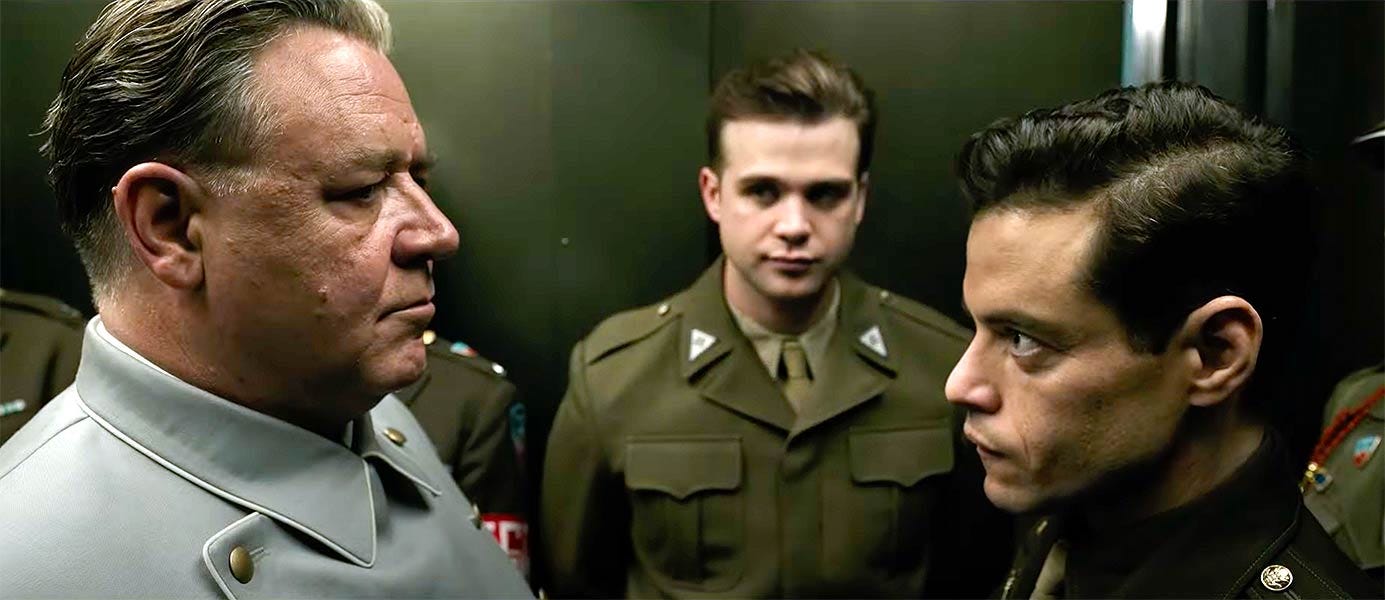
Though not the first film dramatizing the late 1940s Nuremberg Military Tribunals of Nazi war criminals conducted by American occupying forces in Germany, director Stanley Kramer’s 1961 film “Judgment at Nuremberg” is, to date, the best known, fictionalized version of one of the twelve Nuremberg trials. Adding another fictionalized but also vital chapter to that history, director James Vanderbilt’s “Nuremberg” follows WWII psychiatrist and U.S. Army Major Douglas Kelley sent to Nuremberg to determine the psychological fitness of Hermann Göring and other Nazi officers to stand trial.
Among the most powerful of the Nazi elites, creator of the Gestapo and Supreme Commander of the Air Force, Göring became the second most important man in Germany. Designated in 1941 by Hitler as his successor (rescinded by Hitler four days before his suicide April 30, 1945), given the special rank of Reichsmarschall, Göring surrendered May 9 to a division of the U.S. Army. After this surrender depicted in the opening scene, psychiatrist Kelley (Rami Malek) arrives in Nuremberg, surprised at his assignment to evaluate Göring (Russell Crowe). Göring’s mind games and enigmatic disclosures, plus a lifelong addiction to morphine, complicate Kelley’s mission.
Accompanying Kelley as his translator, Howie Triest (Leo Woodall) adds a significant Jewish character and backstory. In a parallel storyline, as the trial approaches, Supreme Court Justice Robert H. Jackson (Michael Shannon) takes on a more prominent role, leading to his problematic cross examination (with dialogue from trial transcripts) of Göring in Courtroom 600. The Palace of Justice, a relatively undamaged building despite several bombings, included an adequate prison and other needed housing facilities. The city Nuremberg was chosen to repudiate symbolically the huge Nazi rallies previously held there.
Based on Jack El-Hai’s 2013 “The Nazi and the Psychiatrist,” with a screenplay by director Vanderbilt, a Machiavellian cat-and-mouse exchange develops between Kelley and Göring. Masters of their craft, Malek and Crowe give crafty performances as Kelly relentlessly but unsuccessfully seeks full disclosure of Göring’s motives for the Nazis’ barbarity. An effective counterpoint, Howie provides an often naïve subordinate who teases out other significant emotional aspects of the fraught situation. So too do Göring’s wife and daughter to whom Kelley delivers letters, as reportedly happened.
Several statements and comments do resonate. The film’s opening text reads, “What follows is based on the account of those who lived through it and those who didn’t.” Later, on the topic of Deputy Führer Rudolf Hess, who flew to England in 1941, also on trial at Nuremberg, Kelley is told, “Just because a man is your ally doesn’t mean he is on your side.” And yet, juxtapositions among the threads and themes are awkward, disjointed and heavy-handed, as pronouncements substitute for revelations. For example, Kelley says, “If we could psychologically define evil, we could make sure something like this never happens again.” Elegant complexity would better serve the traumatic atrocities revisited. Nevertheless, especially for anyone still unacquainted with the horrors of the Nazi concentration camps, the archival black-and-white footage will leave no doubt as to Nazi malevolence. Produced and partially shot by legendary director John Ford, excerpted from director George Stevens 1945 52-minute film “Nazi Concentration and Prison Camps,” this six minutes was part of what was shown at the actual trials. Indisputably, the history presented in “Nuremberg” remains significant. Despite its flaws, this is a powerful, important reminder of the evil that has and still remains within our world. Sony Pictures Classics’ “Nuremberg” is showing at cinemas now and will stream soon.