

There’s no debate over director James Cameron’s extraordinary, even mind boggling visual imagination as he again demonstrates in “Avatar: Fire and Ash.” It is also unfortunately obvious that his and his writing team’s clichéd story lacks the creativity to match Cameron’s pictorial inventiveness. To overlook that would be easy were the dialogue not cringe worthy with reliance on ‘bro’ and numerous colloquialisms that pepper boring dialogue. For “Don’t be a jackass,” “Take the win,” “This is sick, cuz!” and “Let’s do this!” sound less like Na’vi expressions than skate boarders at a local park having a great time. To be fair, a few moving endorsements of humane treatment to each other and extended to animals emphasize solid ethical values, and exhilarating action does whisk viewers through a succession of power struggles and community crises, told with inventive characters and fantastic creatures. But its three hour 17 minute running time can’t quite sustain the predictable, repetitive spectacle.
Familiar characters populate the current “Avatar” chapter. Former human Jake Sully (Sam Worthington) still loves Neytiri (Zoe Saldaña) and lives with the Metkayina Na’vi clan. As events begin, Jake relies on a battery-enabled mask to breath the ambient air. This will lead to several crises. Neytiri, who left the Omatikaya, for the Metkayina, has become, as Saldaña describes her, a “full-blown racist” after humans killed Neteyam, her biological son in the previous “Avatar: The Way of Water.” Kiri (Sigourney Weaver) contributes a reasoned perspective in contrast to the recombinant humans intent on military conquest. Factor in Varang (Oona Chaplin) of the volcano dwelling Mangkwan clan, citizens of the reef clan Metkayina, and Neytiri’s son Lo’ak (Britain Dalton) who narrates events. Mercenaries, hunters, scientists, biologists, and more all contribute to a multilayered struggle for justice, benign power, and honorable behavior pitted against revenge and autocratic domination. It’s complicated but easy to follow by just surrendering to the ride. To avoid spoilers, I leave the nefarious tactics of the villainous humans for individuals’ cinematic experience.
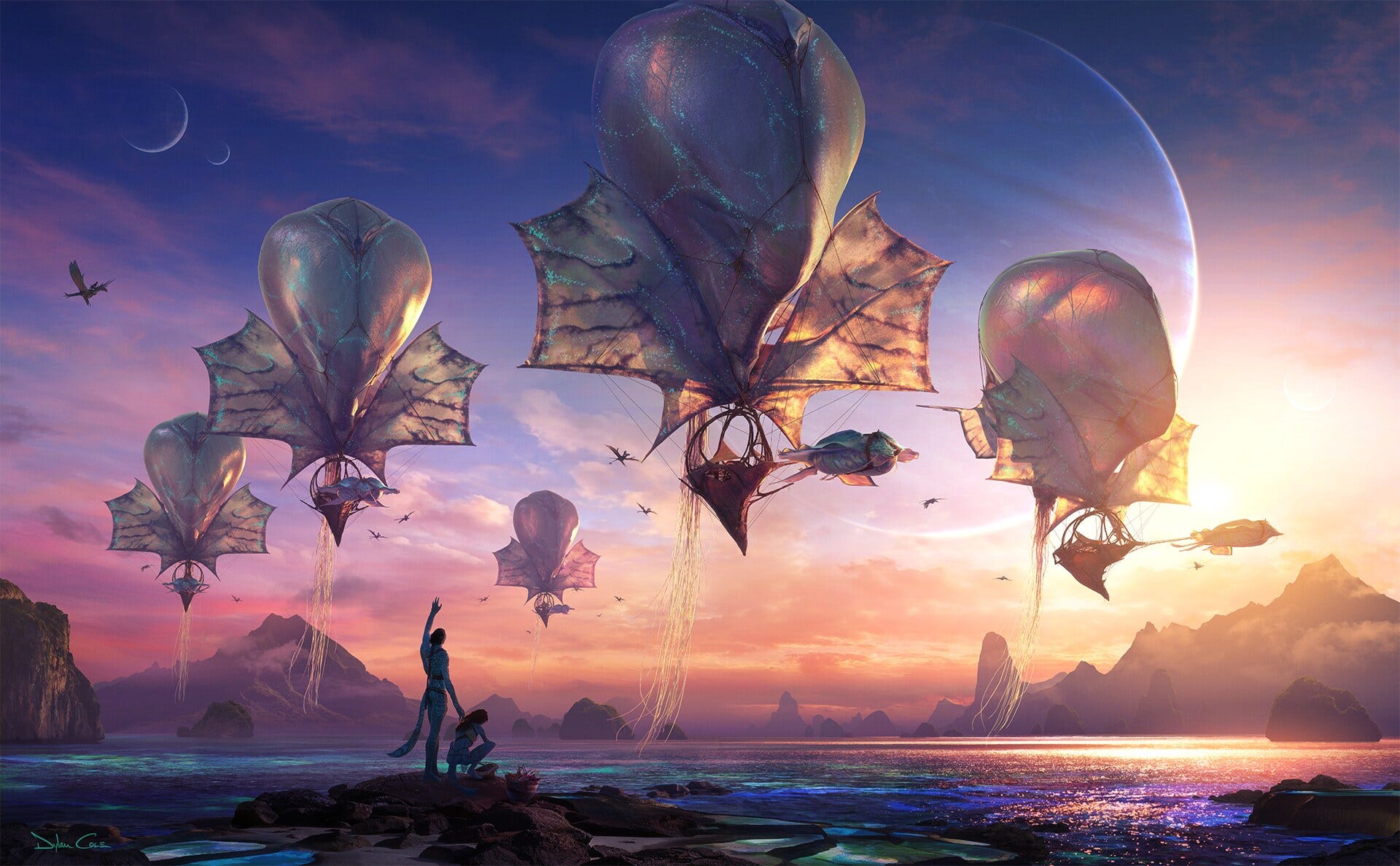
Still set in the 22nd century, returning and new creatures abound. Back are Tulkun (ocean dwellers similar to whales) and Ikran (flying dragon-like athletes), plus more Pandoran fauna. New entries include the Medusoid (soaring, balloon-like organisms that pull sky caravans), Syringil (roughly analogous to manta-rays on steroids), and Night Wraith (a dark, flying predator, as the name signifies). Still beautiful, the bioluminescent forest still factors into the chases and battles, and the characters present gorgeous colors and designs. Throughout the film, Simon Franglen’s score pounds out the action with welcome, softer music in dialogue dominated scenes.
Explaining the “Fire and Ash” of the title, at the D23 fan convention Cameron said, “Think of fire as hatred, anger, violence, that sort of thing, and ash is the aftermath. So what’s the aftermath? Grief, loss, right?” In fact, dialogue explicitly states that “the fire of hate is only the ash of grief.” Significantly, he pursued this idea, asking, “And then what does that cause in the future? More violence, more anger, more hatred. It’s a vicious cycle.” This destructive trajectory plays out with devastating consequences for animals and for nature. Cameron’s heartfelt endorsement and consistent support of constructive environmental solutions inspire his admirable, positive eco-friendly themes in the “Avatar” series. Democracy versus autocracy is also embedded in the conflict with noteworthy, undeniable parallels to today’s crises.
At the 3D IMAX screening I attended (absolutely the way to see “Avatar: Fire and Ash,”) in a short informational segment before the film proper began, Cameron explains his complete rejection of A.I. and his reliance on elaborate performance capture with two cameras mounted in front of the actors’ faces. In this way, he records the nuanced, complex emotional reactions of each character, and the results are impressively delivered through strong performances. “Avatar: Fire and Ash” is the third in the series after “Avatar” (2009) and “Avatar: The Way of Water” (2022), with two more sequels planned, so there’s more to anticipate in 2029 and 2031 respectively. Until then, “Avatar: Fire and Ash” is now screening at local cinemas.