

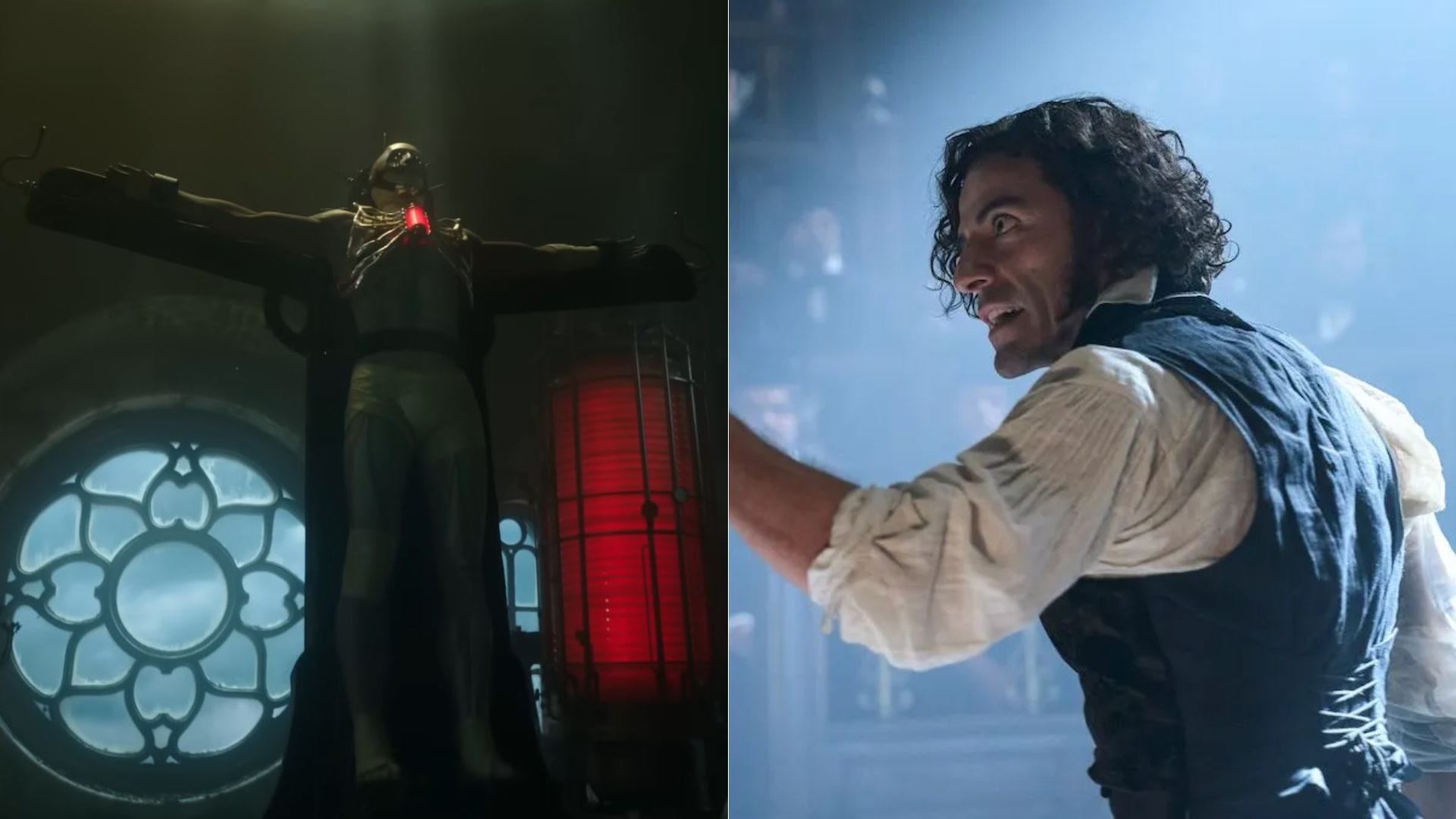
Honoring Mary Shelley’s 1818 novel “Frankenstein; or, The Modern Prometheus” and early film history (albeit with a very modern iteration), Guillermo del Toro’s “Frankenstein” does not disappoint. With Oscar Isaac a perfect choice for the conflicted, brooding Victor Frankenstein, writer/director del Toro magnificently parades his thrilling cinematic imagination for gothic science fiction/horror fare. Alternating between from both Victor’s and The Creature’s (Jacob Elordi’s) point of view, the reimagining of this iconic, haunting story has found the perfect director to interpret Shelley’s still astonishing ideas.
By his own admission, obsessed from the age of 11 on with Shelley’s inventive fabrication, in planning the film del Toro immersed himself in research, studying detailed anatomical illustrations, diverse landscape designs, sculpted human prototypes, atmospheric lighting in classic paintings, varied color palettes, and the earlier cinematic interpretations. All of this clearly factored in to his dazzling concept. In collaboration with Mike Hill, del Toro particularizes Victor’s artistry as Victor struggles to bring his concept to life. Those scenes are as surprising as they are overwhelming, as horrifying as they are beautiful, for Victor emerges not as a monster but as a profoundly emotional being.
In interviews, del Toro cites, as one element of his inspiration, Marco d’Agrate’s 1562 St. Bartholomew marble sculpture in Milan’s Duomo. One of the Twelve Apostoles flayed alive and beheaded, Shelley describes the stretched skin with tendons, muscles, and veins all tangled together. In del Toro’s adaptation, Victor struggles with his creation. Victor’s attention to the protective skin and underlying design of The Creature, as he is listed in the credits, reflects this complexity.
First, however, in an astute decision that adds suspense, the Creature, makes his terrifying presence and his herculean strength known in the Arctic in the opening sequence. Even here, the Creature communicates painful emotional depths which will register as more intense in later scenes, especially when misunderstood and rejected. One interlude in particular featuring wolves and a blind older man elicit heartbreaking empathy for The Creature, his intelligence and kindness ignored and denied by others. As powerful as The Creature’s scenes are, they are matched by Victor’s agony, triumph, and despair. No spoilers, so suffice it to say they involve his mentor Harlander (Christoph Waltz) and Elizabeth (Mia Goth), fiancée of Victor’s nephew.
Technically, as impressive as cinematographer Dan Laustsen’s compositions are, as effective as Alexandre Desplat’s score is, and as masterful as all the performances are, heady philosophical ideas undergird every moment from narcissistic egotism to remorse, unfettered violence to gentleness (a Creature’s scene with a mouse is awe-inspiring), cruelty to what qualifies as human and humane. Typical of del Toro’s art direction, every detail from vibrant colors to luscious costumes deliver arresting images. His vision is imprinted on every frame lifting “Frankenstein” into iconic status. At Telluride where I first saw the film, Oscar Isaac praised the experience of a production of this caliber: haunting, memorable, and transcendent. I agree. “Frankenstein” is at cinemas beginning October 17 and will stream on Netflix beginning November 7.