

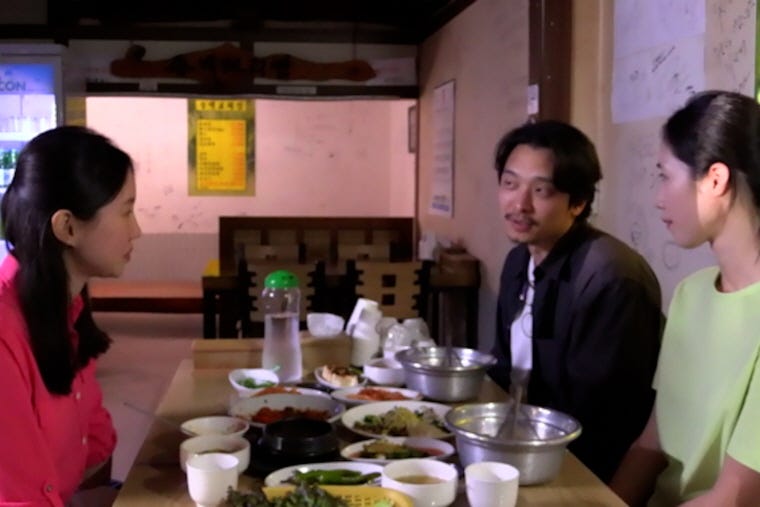
In his 33rd feature film since 1996, South Korean director Hong Sangsoo’s ”What Does That Nature Say to You” is a spare but rich encounter among a small group of individuals. Over the course of a day, five people interact, casually talking and eating, walking in a garden, climbing a mountain, visiting a grave, and watching a sunset, in each instance unintentionally revealing their distinctive, value laden personalities through nonchalant conversation, as always happens in Hong’s dialogue-driven films. The primary person in this understated drama that builds to an inevitable, mildly confrontational upheaval is Ha Donghwa (Ha Seong-guk), an aspiring poet, 35 years old, proudly insisting on his independence from his famous attorney father.
The introduction begins unceremoniously with Ha driving Junhee (Kang Soyi), his girlfriend of three years, from Seoul to visit her family in nearby Yeoju. Arriving at the bottom of the mountain on which the family’s impressive home sits, Ha is astonished that Junhee’s father built it for the now deceased grandmother. Enticed to discover more, Ha drives up the hill where Junhee’s father, Kim Oryeong (Kwon Hawhyo), fetishes Ha’s $2,000, 1996 car. He must take it for a spin.
Thus begins a day of spontaneous interaction with Junhee’s older sister Kim Neunghee (Park Miso) and mother Choi Sunhee (Cho Yunhee). Repeatedly asserting his financial autonomy, paying his way by shooting wedding videos while nurturing his dream to live pursuing beauty, Ha learns that Choi is also a published poet. Summarizing the day’s events, she asserts the most significant observation, noting that “You need to risk your life with fierce candor to be a poet.” Ha will unwittingly risk more than he realizes.
Representative of Hong’s style, extensive exchanges are captured in long takes from a static camera position, often placed behind or to the side of the characters. The effect is to engage viewers with what is said and the reactions elicited, eliminating any distracting camera movement or disruptive quick edits. And the more protracted the scene, the more the power shifts in subtle and astonishing ways. This is dramatically evident in the dinner scene with the entire family and Ha divulging principles that often do not align. In a cunning, sly strategy, Junhee’s father plies Ha with expensive alcohol, its effect culminating in revealing comments and denials. Hong alerts all viewers to pay careful attention to the hidden revelations embedded in what we say and what we hear in all our discussions. We have been alerted through his wise attentiveness, knowing, as his title signals, what “that nature” says. In Korean with English subtitles, “What Does That Nature Say to You” screens Friday, March 13, through Sunday, March 15, at Webster University’s Winifred Moore auditorium at 7:00 p.m. each of those evenings. For more information, visit the film series website.