

As Webster University’s film series has amply illustrated, Hong Kong writer/director Wong Kar Wai creates artistic films dominated by style rather than narrative. This means that while Wong disdains complex, convoluted narratives what does occur is presented stylistically, beautifully, with intense emotions simmering just below the surface. As poignantly demonstrated with “In the Mood for Love” and “2046,” both set in his native Hong Kong, Wong depicts the deep seated pain of, amidst longing for, intimate relationships. In “My Blueberry Nights,” Wong’s 2007 English language debut and his only film in English, he again mines the emptiness and distress of broken hearts and the ineffectual struggle to move on though incorporating more plot and locations than usual. Nevertheless, his signature style of neon lighting, partially obscured framing of characters, voiceover narration, and perfect interpretive music remain. In effect, all his choices meticulously reveal his introspective, authentic individuals.
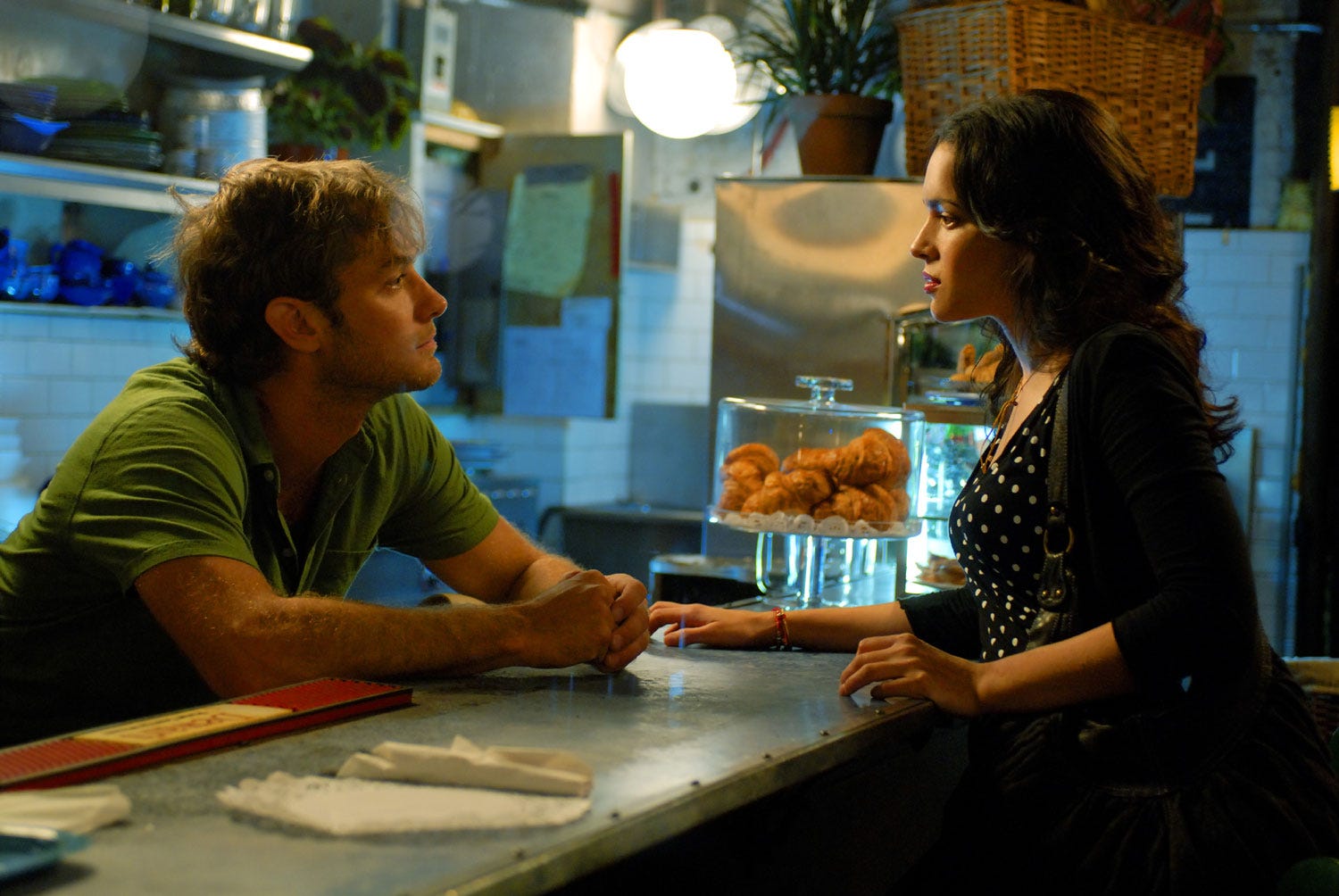
In “My Blueberry Nights,” Wong anchors events in a New York cafe where the central character Jeremy (Jude Law) works and an array of customers visit. True to the essence of Wong’s characteristic concern for lost love, Jeremy keeps a jar with keys left by customers whose relationships have ended—the keys waiting for the significant others to claim them. One such person, Elizabeth (Norah Jones), returns repeatedly to the café, finally giving up on her cheating ex after voyeuristically watching him with another woman. Deflated and depressed, Elizabeth flees across America to find and, hopefully, to heal herself. Now known as Lizzie, she works two jobs in Memphis, one at a bar and one in a diner, where another person’s heartbreaking, broken relationship takes center stage. Separated from his wife Sue Lynne (Rachel Weisz), a devastated Arnie Copeland (David Strathairn) works as a local policeman, drinks too much, and pines morosely for Sue Lynne. That couple’s volatile relationship will erupt with no satisfactory conclusion.
Still seeking contentment, Lizzie, now as Beth, moves on to Nevada where a father-daughter disconnect steers scenes with Leslie (Natalie Portman), an exceedingly confident poker player. All the while Elizabeth/Lizzie/Beth sends post cards back to a pining Jeremy who has unsuccessfully attempted to find her. Characteristically, Wong Kar Wai presents all these relationships with an eye to stunning art direction, inferring individuals’ emotions through striking, vivid colors, often keeping the subjects in shadowy, claustrophobic spaces. He also selectively uses time lapse, slow motion, and speeded up footage to interpret dynamic interaction with a speeding subway train in New York and lovely but barren landscapes on the road as punctuation. Moody music gives voice to unspoken yearning and heartache.
The importance of music is fitting since Norah Jones plays Elizabeth with Jude Law as Jeremy and solid supporting performances by David Straithairn, Rachel Weisz, and Natalie Portman. “My Blueberry Nights” takes its title from the pie that is never requested at the diner, a complete pie left every night. But, as Jeremy explains, “It isn’t the fault of the blueberry pie. There’s nothing wrong with it. It’s just nobody wanted it. You have to make choices.” An excellent choice is Wong Kar Wai’s slow-paced rendering of Elizabeth regaining her equilibrium in this absorbing contemplation of loneliness and loss and the courage to love again.
First on this night’s program before “My Blueberry Nights,” “The Hand” (2004, 56 minutes) focuses more narrowly on professional escort and mistress Miss Hua (Gong Li) and her apprentice dressmaker Xiao Zhang (Chang Chen) who is enamored of her. An assistant to master tailor Jin (Feng Tien), Zhang, sent to take Miss Hua’s measurements, is seduced by her both physically and emotionally. Despite Zhang’s devotion to and obsession with Miss Hua, class and personality differences keep their potentially passionate relationship in limbo, despite Zhang’s clearly agonized desire. Sensuous and gorgeous, the beautiful fabrics belie the tortured, unconsummated love.
Originally 43 minutes, “The Hand” was part of the three-part, 2004 anthology film “Eros” that also included short films by Steven Soderbergh and Michelangelo Antonioni. In “The Hand,” gifted cinematographer Christopher Doyle frames characters partially obscured, turned away or slightly out of focus, lower legs or only feet shown, or backs to the camera. Appropriate for the content, scenes are often darker than in Wong’s other films, grays and blacks dominating here with even several of the glamorous dresses of darker hues. At times, purple defines a scene, as opposed to vibrant reds and greens that suffuse compositions in other Wong films. Equally of interest, a circular narrative suggests we may all end up right back where we began.
“The Hand” (2004, 56 minutes) is in Mandarin with English subtitles and “My Blueberry Nights” (2007, 95 minutes) is in English. Both screen at Webster University’s Winifred Moore auditorium Tuesday, May 12, at 6:45 p.m. For more information, you may visit the film series website at: Webster.edu/filmseries.