

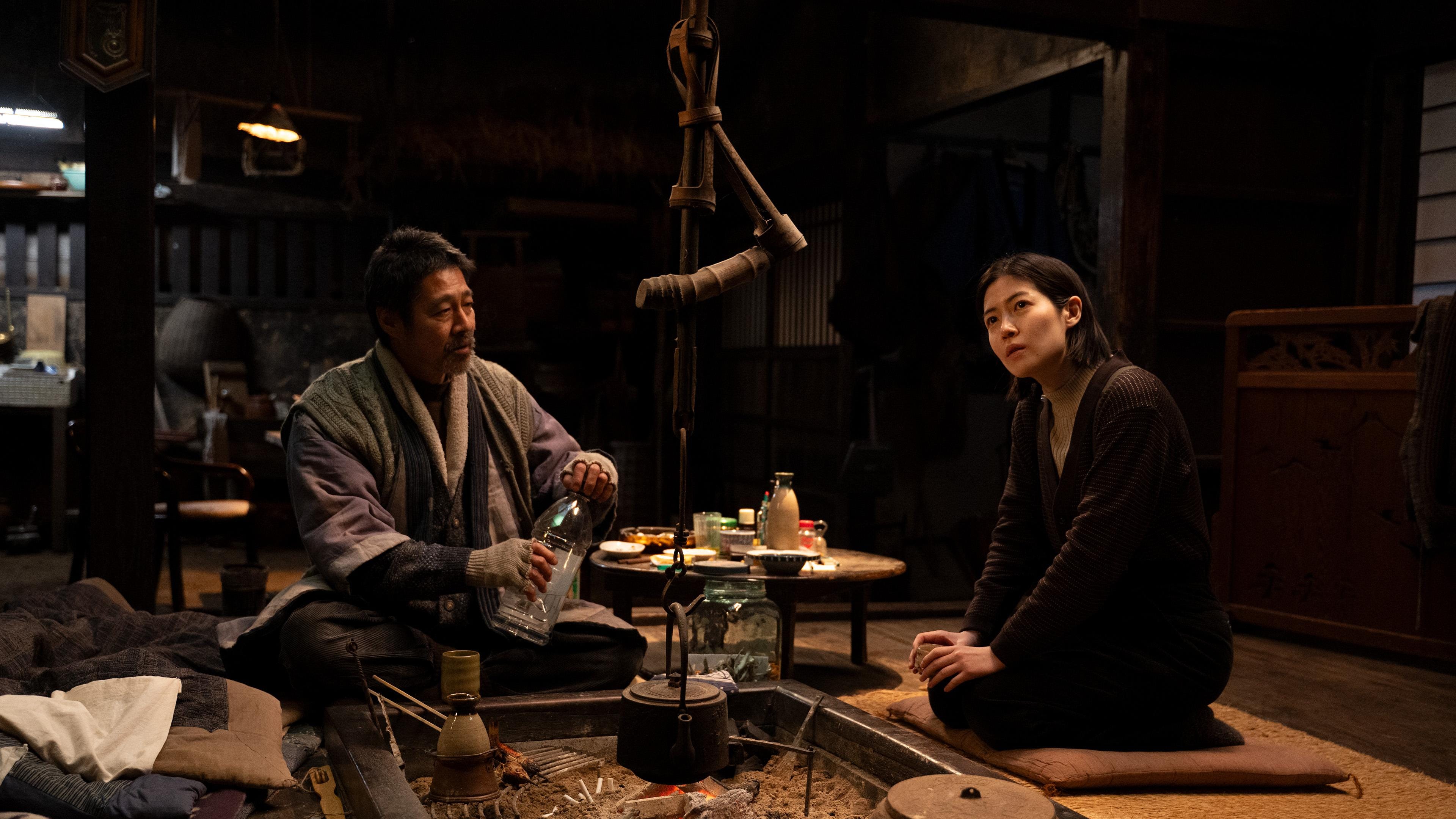
A wistful, meandering series of encounters graces Japanese director Sho Miyake’s “Two Seasons, Two Strangers.” Adapting and merging a pair of Yoshiharu Tsuge’s manga short stories, namely “A View of the Seaside” and “Mr. Ben and His Igloo,” Sho follows his despondent, wandering characters through predominantly quiet, deeply introspective moments. As the title suggests, in the distinctively different environments of a wind-whipped seaside and a snowbound, rather decrepit mountain inn, individuals completely unfamiliar with each other initially will cross paths with inadvertent, but ultimately fortuitous, effects. More surprisingly, understated, beneficial bonding will subtly, almost imperceptibly, transform each participant in gratifying ways.
Uniting the disparate characters and events, Japanese based, Korean screenwriter Li (Shim Eun-kyung) initiates the first sequence and navigates the third. In the opening scene, sitting at her desk, lacking the creative inspiration to develop a story, Li imagines two teenagers at a seaside village, unexpectedly sharing a nearby beach. In what is surely a metaphoric geography of formidable rocky cliffs yielding to an inviting sandy shoreline, vacationing Nagisa (Kawai Yuumi) tentatively and awkwardly makes a few comments to Natsuo (Mansaku Takada), visiting family. This scene comes to life as Li’s scripted film within Miyake’s film, a striking layering. Amidst disruptive winds that add another powerful, symbolic presence, through tentative conversations, Nagisa and Natsuo strike up an exploratory friendship, wading into and swimming in the ocean, meeting purposely a second time in pouring rain. Nagisa reveals a disturbing memory before director Miyake again surprises viewers, cutting to a classroom screening of Li’s scene with her and that film’s director on stage for a Q&A. Responding to her mentor’s gentle criticism and a student’s question, a disconcerted Li demurs, self-deprecatingly saying, “I don’t have much talent.” Thus begins her quest for a measure of elusive confidence or, at least, contentment, though Li never articulates her aspirational goal. Clearly, Miyake prefers suggestion over explicit narrative pronouncements.
Hiking to a snowy mountainous village, without a reservation, Li can’t secure a room. With the recommendation of one helpful clerk, Li will trudge deeper (and again metaphorically) into increasingly remote, all but inaccessible snowbound terrain where she finds Benzo (Shinichi Tsutsumi). Holding forth in a bare bones, very cold, derelict inn, Benzo allows Li to settle in. As they unhurriedly converse, a wealth of emotional revelations illuminate their challenging crises, Benzo a divorced father, Li still seeking—what? Her muse? Inspiration? Escape? Now with one of her mentor’s still image cameras, perhaps she is seeking to capture the ineffable.
In touch with his muse and certain of his journey, Miyake depicts a time when an outsider’s dissimilar circumstances quite curiously and inexplicably impact another person’s problematic situation. This interrogation of life’s accidental interactions that prompt existential contemplation and discovery moves slowly but masterfully through those indescribable and unanticipated twists of fate that inform and educate each person open to such experiences. This special, unique jewel of a film invites meditative reflection of each viewer’s receptivity, or absence thereof, to such rewarding occurrences when individuals’ lives intersect in coincidental and valuable ways.
Nominated for and winner of multiple awards, in Japanese with English subtitles, “Two Seasons, Two Strangers” screens at Webster University’s Winifred Moore auditorium Friday, May 22, through Sunday, May 24, at 7:30 p.m. each evening. For more information, you may visit the film series website at: Webster.edu/filmseries.