

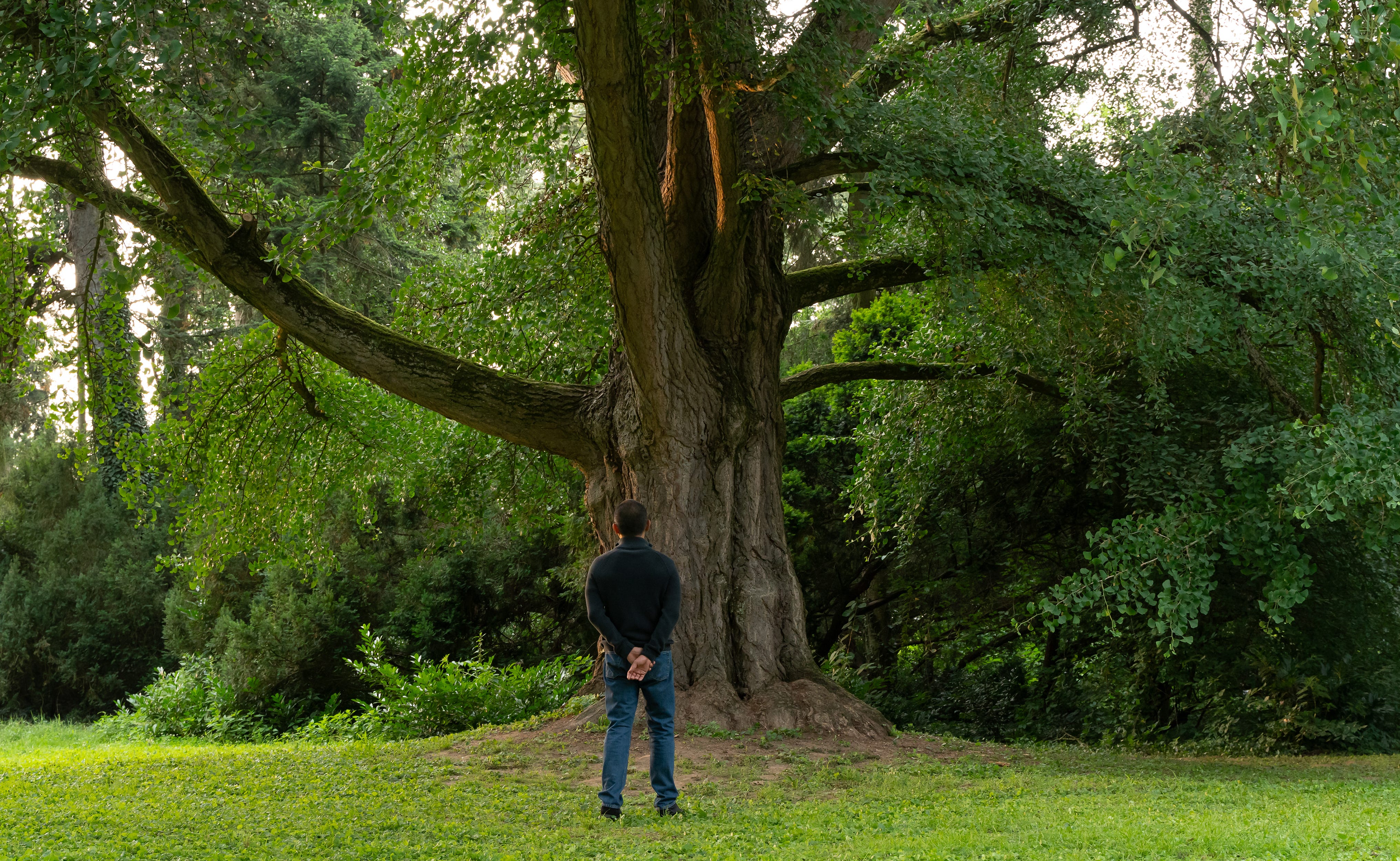
In the intriguing, elusive, and perplexing “Silent Friend” (“Stille Freundin”) Hungarian writer/director Ildikó Enyedi interlaces three related stories set in 1908, 1972, and 2020 respectively. All events revolve around a magnificent, centuries old gingko tree in Marburg, Germany, the town housing the University of Marburg, the world’s oldest (1527), Protestant-founded University. In the first story presented, set in 2020, this scholarly institution lures Dr. Tony Wong (Tony Leung Chiu-wai), a neuroscientist from Hong Kong, with promises to support his interrogation of the consciousness of newborns under six months, up to the age when they start to speak.
When the COVID pandemic interrupts his teaching and experiments, Wong wanders into and becomes enamored of the Botanischer Garten Marburg, home to the grand 1832 gingko tree. Encouraged in Zoom chats by French botanist Dr. Alice Sauvage (Léa Seydoux), Wong pivots his scientific study to the gingko, theorizing an intangible but detectable correlation between the gingko’s and his own neurological activity. Wong seeks parallels through a scanner he invents. Observing and objecting, the university janitor Anton (Sylvester Groth) (possibly a second silent friend) watches and interferes before an understanding develops. All of these details and more are interspersed throughout the film’s two hour 27 minute running time, creating a provocative juxtaposition of dissimilar systematic inquiry.
In that vein in 1972, self-assured Gundula (Marlene Burow) pursues her certainty on the consciousness of a geranium, measuring its ‘language’ in response to her meticulous attention to its care. Meantime, basking in Gundula’s garden perusing a good book, Hannes (Enzo Brumm) is soon roped into her studies and her life. Sandwiched in between the 2020 and 1972 plot threads, moving back historically to 1908, feminist Grete (Luna Wedler), the first woman candidate seeking official university admission, endures an insulting, sexist interview by the botanic department’s professors. Through her expert answers and unruffled composure, despite repeated questions about Linnaeus’ taxonomy categorizing the sex-lives of organisms, the admissions board members will be astonished and humiliated by Grete’s thorough knowledge. Admitted albeit with rough patches ahead, her journey will detour to a photographer’s assistant and then a professional in her own right.
With all the 1908 scenes in exquisite black and white (appropriate for the earliest chronological accounts), there’s no problem keeping the three parallel narratives clear. In addition cinematographer Gergely Pálos shot each of the three segments in a different format. As Enyedi describes her collaboration with Pálos, we chose black-and-white 35 millimeter film for 1908, the lush but imprecise 16 millimeter film for 1972, and the piercing exactness of digital images for 2020. Visually enlivening all this, swirling, fanciful neon images illustrate neurological communication along with original animated videos of past experiments testing infants’ neural reactions to various stimuli. The density of the three chronological contexts, the distinctive inquiries into and evaluations of plant communication, the complementary music and sound by Gábor Keresztes and Kristóf Kelemen: all this adds another layer of uncanny engagement with plants and trees in ways normally not envisioned in fictional films.
In press notes, Enyedi says, “My intention was to raise questions and bring certain, for me exciting, topics into light for further exploration.” Regarding a tree’s perception of the world, Enyedi defines her objective as desiring “to draw attention to the fact that it is a complex being with its own perceptional world, its ‘Umwelt’ equally valid to ours.” Crediting neuroscientist Anil Seth’s book “Being You” and his research on consciousness as her primary inspiration, Enyedi notes that in their efforts to connect with nature, each individual will “discover not only the plants but also themselves.” Her unique, passionate responsiveness to the natural world informs her earlier films as well. For example, in “Magic Hunter,” her second feature, Enyedi details an oak tree’s six hundred years. In “Simon the Magician,” a potted plant solves a murder case. As a bonus here, her astute investigations of nonhuman communication yield benefits for viewers whom she prompts to expand their own interest in a world possibly unexplored, even envisioned, in quite these ways. The effect is as potentially exhilarating as it is rewarding. In English and German and some Cantonese with English subtitles, “Silent Friend” screens at Webster University’s Winifred Moore auditorium Friday, May 29, through Sunday, May 31, at 7:30 p.m. each of those evenings. For more information, you may visit the film series website at: Webster.edu/filmseries.