

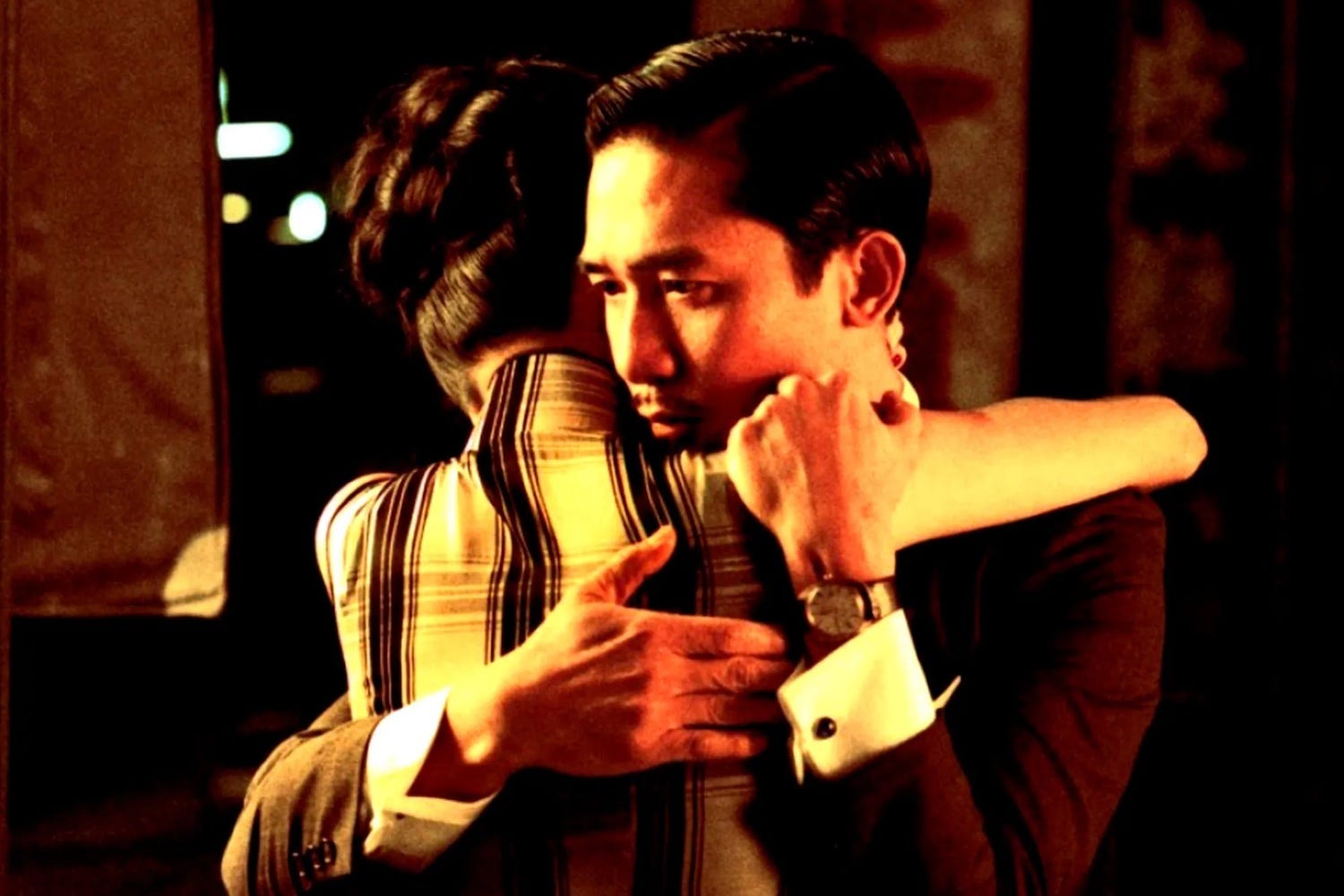
Hong Kong writer/director Wong Kar Wai completes his loosely united trilogy of “Days of Being Wild” (1990) and “In the Mood for Love” (2000) with “2046” (2004). Each film stands solidly alone, though acquaintance with Wong’s aesthetic virtuosity does prepare one for this richly illustrated, haunting addition to journalist Chow Mo-wan’s bereft, nostalgic longing. Wong Kar Wai’s earlier works, impressive in their own right, do not fully anticipate the extraordinary visuals that open “2046.” There, an immediate immersion in a dazzling swirl of vibrating, futuristic neon images introduces Chow’s science fiction novel as a stunning, unexpected development.
Opening voiceover narration complements and interprets the scene as follows. “In the year 2046, a vast rail network spans the globe. A mysterious train leaves for 2046 every once in a while. Every passenger going to 2046 has the same intention. They want to recapture lost memories. Because nothing ever changes in 2046, nobody really knows if that’s true because nobody’s ever come back. Except me.” Continuing the explanation, a 2046 resident describes the whispering of secrets into a tree hole, then covered with mud so “nobody else would ever discover it.” Thus Wong initiates a philosophical trip, asserting “All memories are traces of tears.”
Then, in present-day Singapore, Chow Mo-wan (Tony Leung Chiu-wai reprising his earlier role) encounters Black Spider (Gong Li), a professional gambler with whom he had become involved in Hong Kong. Rejected and affirming “I have no prospects here,” Chow returns to Hong Kong, December 24, 1966. Jolting the narrative back to 1966 Hong Kong, Wong inserts a grim background through several seconds of black-and-white archival footage of the 1966 riots. Thus political versus personal trauma informs “2046’s” provocative juxtaposition of romantic infatuation and science-fiction fantasy versus a governmental/civilian crisis. Though focused on Chow’s past, present, and future, through briefly interjected 1966 and 1967 news video, Wong fashions a gravity-defying balancing act that invites consideration of the individual versus the collective. He thereby adds an unexpected (given his previous work), more radical context.
Nevertheless, in Wong’s characteristic, mesmerizing flow of images and music, “2046” is reminiscent of “In the Mood for Love” and extraordinary in its own right. Incapable of integrating his passion for Su Li-zhen (Maggie Cheung in flashbacks) into his current affairs with, among others, Bai Ling (Zhang Ziyi), Chow suffers and nurtures profound heartbreak. As a counterpoint, his landlord’s older daughter, Wang Jing-wen (Faye Wong), loves a Japanese businessman (Takuya Kimura) to whom her father objects. Though this may sound quite complicated, the characters’ interconnections remain clear, offering an eloquent exploration of constructive and destructive relationships, all with their own unique, emotional challenges.
Revisiting Chow on each Christmas Eve from 1966 through 1969, events flow seamlessly, not always in chronological sequence but never confusing. Exquisite cinematography by Christopher Doyle, Kwan Pun Leung, and Lai Yiu-fai, bathes scenes in red or green, greys or blues, each an appropriate translation of the emotions defining those moments. In addition, in visually arresting compositions, Wong presents characters’ exchanges by blocking off part of the frame with a door or a window, presenting areas in focus with other details out of focus, or even showing only the lower leg or feet. The effect is to invite captivated viewers to appreciate and relish his artistry. If all that is not sufficient, the music is mesmerizing, especially Shigeru Umebayashi’s main theme. Adding evocative associations, Nat King Cole’s “The Christmas Song” plays in the background with Connie Francis, Dean Martin, Xavier Cugat, and others adding musical environments. “2046” is an extraordinary cinematic achievement, four years in production, and unforgettable, an ironic comment on the memories Chow strives to bury.
In Cantonese, Mandarin, and Japanese with English subtitles, “2046” screens at Webster University’s Winifred Moore auditorium on Tuesday, May 5, at 7:00 p.m. that evening. For more information, you may visit the film series website at: Webster.edu/filmseries.