

Independent writer/director Charles Burnett received national recognition for his stunning “To Sleep with Anger” (1990) starring Danny Glover. Before that, Burnett became an acknowledged national treasure, selected to receive a 1988 MacArthur fellowship, the so-called “genius award” for which no one can apply. But Burnett has toiled as a filmmaker for over two decades, making his first student film at UCLA in 1969 and his first feature, “Killer of Sheep,” in 1977.
So it is by deliberate and masterful design (not a lack of acquaintance with the formulas) that Burnett intentionally and inventively avoids conventional Hollywood content and style. Hoping to prompt thoughtful reception, his films require careful consideration of the complex social and emotional circumstances influencing and restricting Black middle-class characters. The point is not escapist entertainment. Instead, meandering, episodic plots and often seemingly amateurish acting lead us to realize that these characters have an honesty and realism that few films ever achieve.
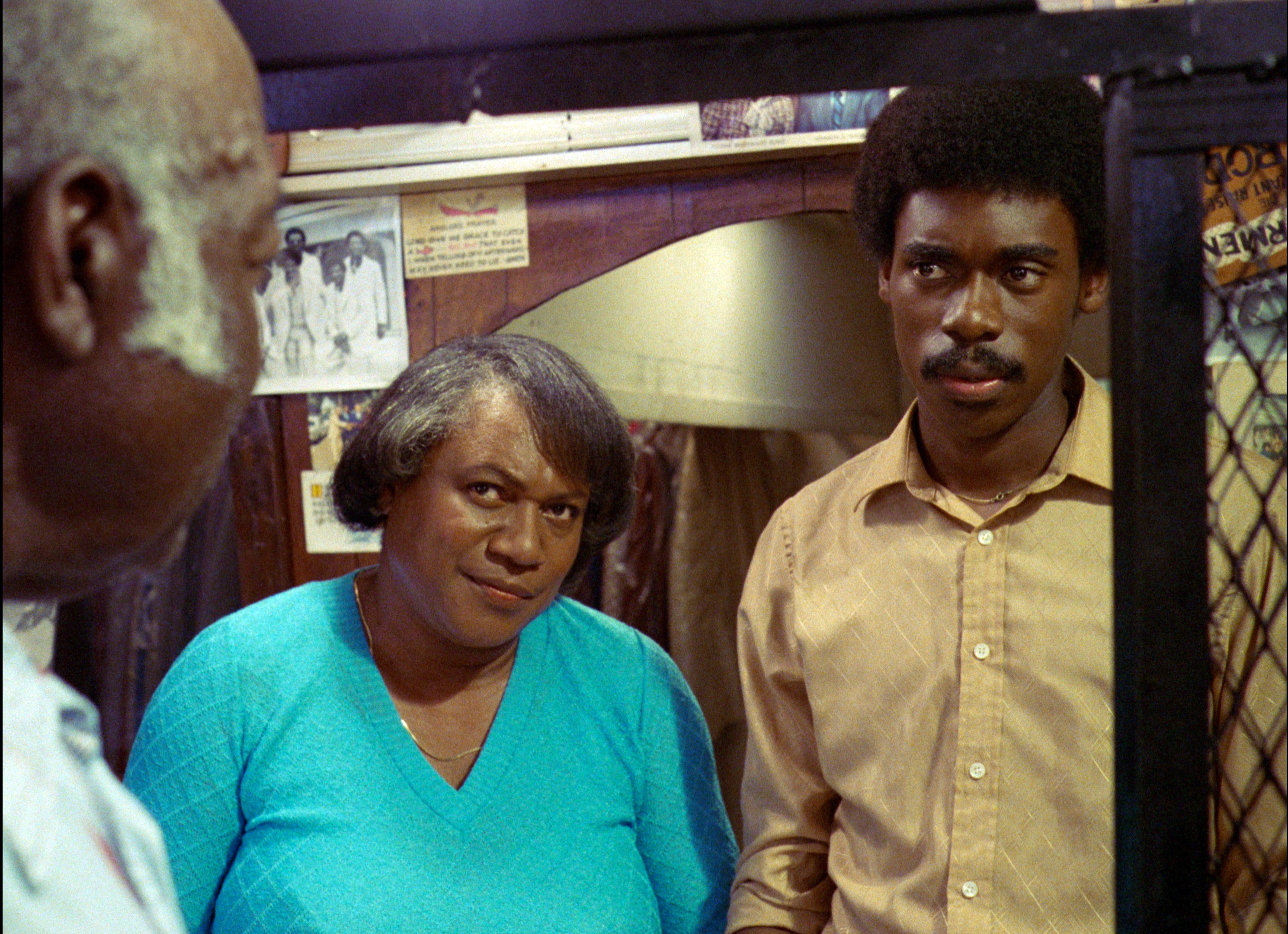
Singled out for exceptional praise upon its release in 1984, “My Brother’s Wedding” is vintage Burnett--full of cultural introspection, irony, and humor presented through atypical, multidimensional characters. In this film, it’s Pierce Mundy (Everette Silas) who works at his parents dry cleaners, kicks around the neighborhood, and hangs out with his friend Soldier (Ronald E. Bell) when Soldier isn’t in jail. The imminent wedding of his brother to a wealthy, ambitious woman creates a jarring tension in the Mundy family, especially when Pierce must choose between the marriage he detests and serving as pallbearer at his dear friend’s funeral.
Customers come and go at the cleaners, several people ask for work, confrontations occur among friends and in their romantic affairs, Mrs. Mundy (Jessie Holmes) strives to give some religious guidance, and a dozen commonplace and a few dramatic encounters ensue over a couple days in Pierce’s rather unfocused life. Economic conditions, family relationships, community predicaments: all offer an authentic snapshot of this world. Seldom does any character achieve empowerment or triumph over psychological and socioeconomic limitations. But by the narrative’s in media res conclusion, Burnett’s audience knows what it feels like to inhabit Pierce’s life in his vividly presented South Central L.A. environment.
On the occasion of its 4K restoration, in press notes, Burnett explains that the catalyst for the film came from his own conflict having to choose attending a good friend’s funeral or a co-worker’s wedding, both occurring at the exact same date and time. Also factored in, concerning Pierce’s social dilemma, Burnett adds that he knew “a lot of kids trapped in this sort of situation. . . how could you be an aide to someone, a responsible person, and you yourself are not capable of dealing with these issues.” Addressing all this through Pierce, Burnett presents a three-dimensional depiction of Black life in the LA 80s. And though his films dance to the beat of a different drummer, we would do well to catch the rhythm. In a 4K restoration, “My Brother’s Wedding” will screen at Webster University’s Winifred Moore auditorium Sunday, October11, and Thursday, October 15, at 7:00 p.m. each of those evenings. For more information, visit the film series website