

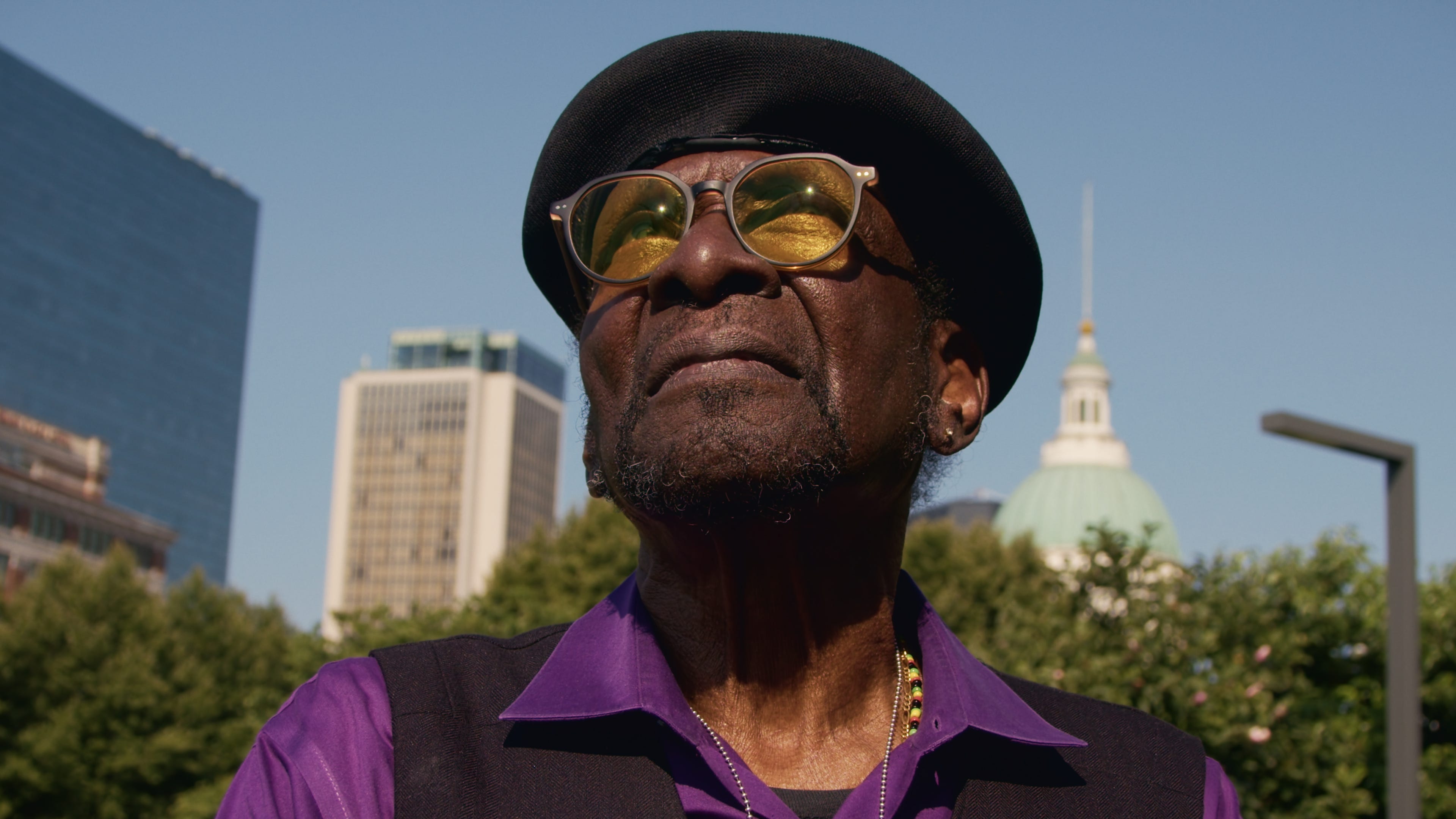
As chronicled in Joseph Puleo’s “Percy Green: Man of Action,“ Green’s lifelong example of confrontational politics and proactive targeting of companies practicing racial discrimination improved opportunities for Black Americans. From selling papers as a boy in segregated St. Louis to becoming a civil rights activist in newspaper headlines, St. Louisan Percy Green immensely advanced racial equality. As he states in the introduction to the documentary, describing the goals of ACTION (Action Council to Improve Opportunities for Negroes), an organization he founded in 1964, “Our role was one of developing issues, trying to convey those issues to the larger community, and to punish the adversary.”
In advancing those endeavors, historian Gwen Moore notes, “He is an organizational genius when it comes to tactics and strategy.” Contemporary, first-person interviews with historians, with men and women who joined with Green, and with Green’s son substantiate Moore’s claim. A wealth of archival resources (photos, newspaper articles, television interviews, and news footage, some of the resources never seen before) provides evidence of Green’s impressive impact. As Puleo notes, “Percy’s name appeared almost daily in St. Louis newspapers and beyond for over 20 years.” In addition, Percy’s mid-1970s book, “Why You Must Raise Hell,” became another fabulous resource. Further enhancing the documentary’s appeal, Puleo explains that “animation supplemented key moments when archival material was unavailable.”
Percy Green’s background adds context. Born in the St. Louis Compton Hill neighborhood in 1935, Green graduated from Vashon High School in 1954 and began work as an engineer at McDonnell Douglas in 1956. At the urging of a colleague, he attended a meeting of CORE (The Congress of Racial Equality), and, as the cliché goes, the rest is history, and what a history it is. Among numerous, noteworthy actions, July 14, 1964 Green and fellow CORE member Richard Daly climbed a ladder on one leg of the Gateway Arch during its construction. Here and as Green made clear in other protests, Blacks were largely excluded from good jobs. After several hours, Green and Daly climbed down, Green arrested immediately; Daly, who was white, a bit later. Thirty days after that, McDonnell Douglas informed Green of his layoff, on his 29th birthday. This led to the landmark civil rights case, McDonnell Douglas Corp v. Green, decided unanimously by the Supreme Court for Green. It is a racial discrimination case still cited today.
A second momentous protest of many initiated by Percy involved the St. Louis Veiled Prophet Ball, an elite, all white Christian event. This involved unmasking the hooded Veiled Prophet by an ACTION member. Other conflicts involved Catholic, Episcopal, Jewish, and Black places of worship; Union Electric, SW Bell, Laclede Gas, Wonder Bread, Hostess, and earlier (in 1963) Jefferson Bank which employed no Black tellers despite many Black customers. A through line in all this was advocacy for good-paying jobs for Black men. He veered into some less admirable activism upon occasion, though Percy never sacrificed his principles even though arrested over one hundred times and held for 90 days in the City Workhouse for civil disobedience. Finally, in 2024 the City of St. Louis honored Green for his lifetime of dedication to civil rights. His legacy is secure, the history of his achievement important for all to recognize and applaud. Nine PBS (St. Louis channel 9) will broadcast “Percy Green: Man of Action” on Monday, October 27, at 7:00 p.m. Saturday, October 25, at 7:30 p.m. an additional community event with a free outdoor screening will take place at Kiener Plaza. All are welcome.