

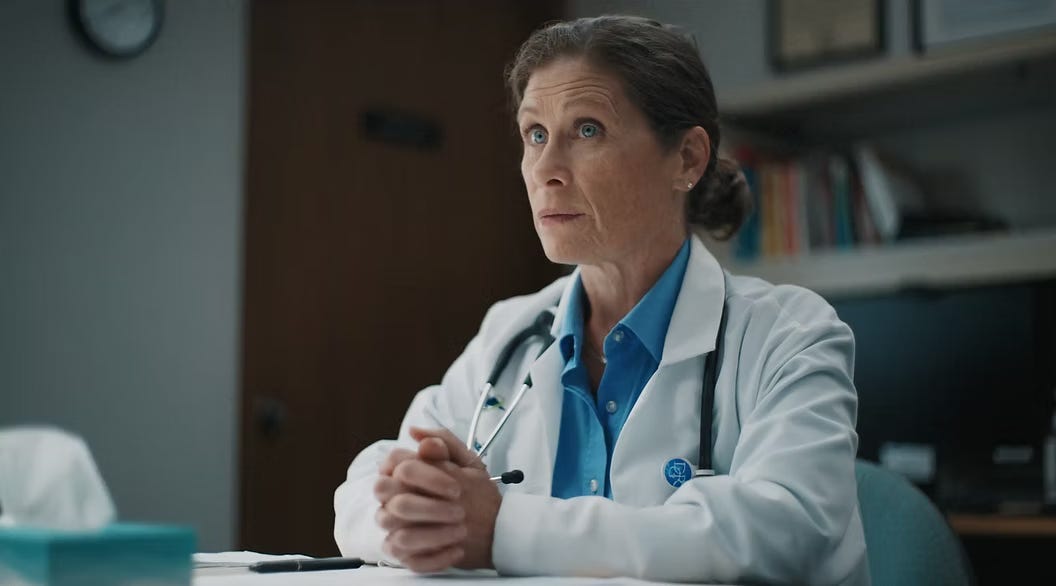
Nathan Deming’s “Winter Hymns” opens on a snowy day in Menomonie, Wisconsin, with Dr. Linda Vobernik (Colleen Madden) in her spacious office where she will spend the remainder of the day and the film. A palliative care doctor for three years after moving over from family care practice, this day Dr. Vobernik will meet from early morning to night with an almost nonstop succession of patients, all with terminal diagnoses. Their personalities range from inspiringly accepting of their impending death to unbridled anger, from confusion to clarity, from benefitting from family support to facing abandonment and rejection. What never varies is Dr. Vobernik’s professional, erudite responses to each patient as she astutely assesses their attitudes and acceptance, or lack thereof. Her emotional control and psychological insights exemplify a master therapy session as she challenges some patients, provides emotional support to others, contradicts a few, and remains silent with others.
She skillfully pushes one retired schoolteacher, avoiding end-of-life decisions by enthusiastically talking about her past students, to choose and sign her final medical directives. She rejects one ovarian cancer patient’s attempt to get a new prescription for oxycodone. She turns off the office lights for a priest suffering from a painful migraine and doubts about his faith. Nevertheless, the daughter of a military chaplain, without a pause Dr. Vobernik rejects the priest’s idea of sin when he describes his suffering as that for a ”sineater,” a cultural figure a community pins its hopes on, someone to absorb their pain. She provides a VR headset for a woman who always wanted to visit Paris and can now do so virtually. She remains quiet when needed, ushers one person’s irate daughter out of the room, asks revealing questions, or (most of time) just listens. And she calmly describes the physical changes that occur upon death, clarifying also that palliative care is support but not a cure.
Like the great HBO series “In Treatment” starring Gabriel Byrne as psychotherapist Paul Weston, Dr. Vobernik’s receptivity to individuals with dramatically different personalities models a superb understanding of the human species and the gift of empathy devoid of sentimentality. After graduating from Webster, writer/director Deming studied with the great British director Mike Leigh, another person who exhibits extraordinary insight into the vicissitudes of individuals’ struggles. In the appropriately named “Winter Hymns,” Deming charts his own course, while both directors’ ability to present less-than-perfect men and women in a dramatically engaging manner shines through. In short, it’s a pleasure to be with authentic characters, to acknowledge their limitations, and to care deeply about them.
Perfect pacing matches Dr. Vobernik’s excellent ability to deal constructively with her patients. Technically, pauses are inserted when needed and rushing ahead when appropriate. Brief comments add backstory. Dr. Vobernik’s mother died five years earlier, suggesting this as the catalyst for her starting the palliative care department at St. Luke’s Hospital. As Dr. Vobernik, Collen Madden anchors and guides every scene, a charismatic screen presence. Her measured responses boost a film that could have grown exhausting, even depressing, into something quite different; that is, thoughtful, disarming, and heartening. “Winter Hymns” accomplishes a highwire act: an exceptional, upbeat film about death, modeling lessons in compassion, responsiveness to our fellow travelers, and a reminder of how fleeting and precious life is. With Webster University graduate and director Nathan Deming in attendance, “Winter Hymns” screens at Webster University’s Winifred Moore auditorium Thursday, September 10, at 6:30 p.m. that evening. For more information, visit the film series website