

If, as the cliché states, a picture is worth a thousand words, then writer/director Rafael Manuel’s “Filipiñana” speaks volumes. Told entirely from 17-year-old Isabel’s point-of-view, the disparity between the wealthy who exploit the Philippines’ landscape in order to indulge their love of golf and those who serve them dominates this minimalist, unpretentious but scathing critique. Newly employed at the luxurious Manila country club Alabang, rural, naïve Isabel wanders the grounds and the clubhouse, quietly observing and yet affectively registering the astonishing servitude of the young women who work there.
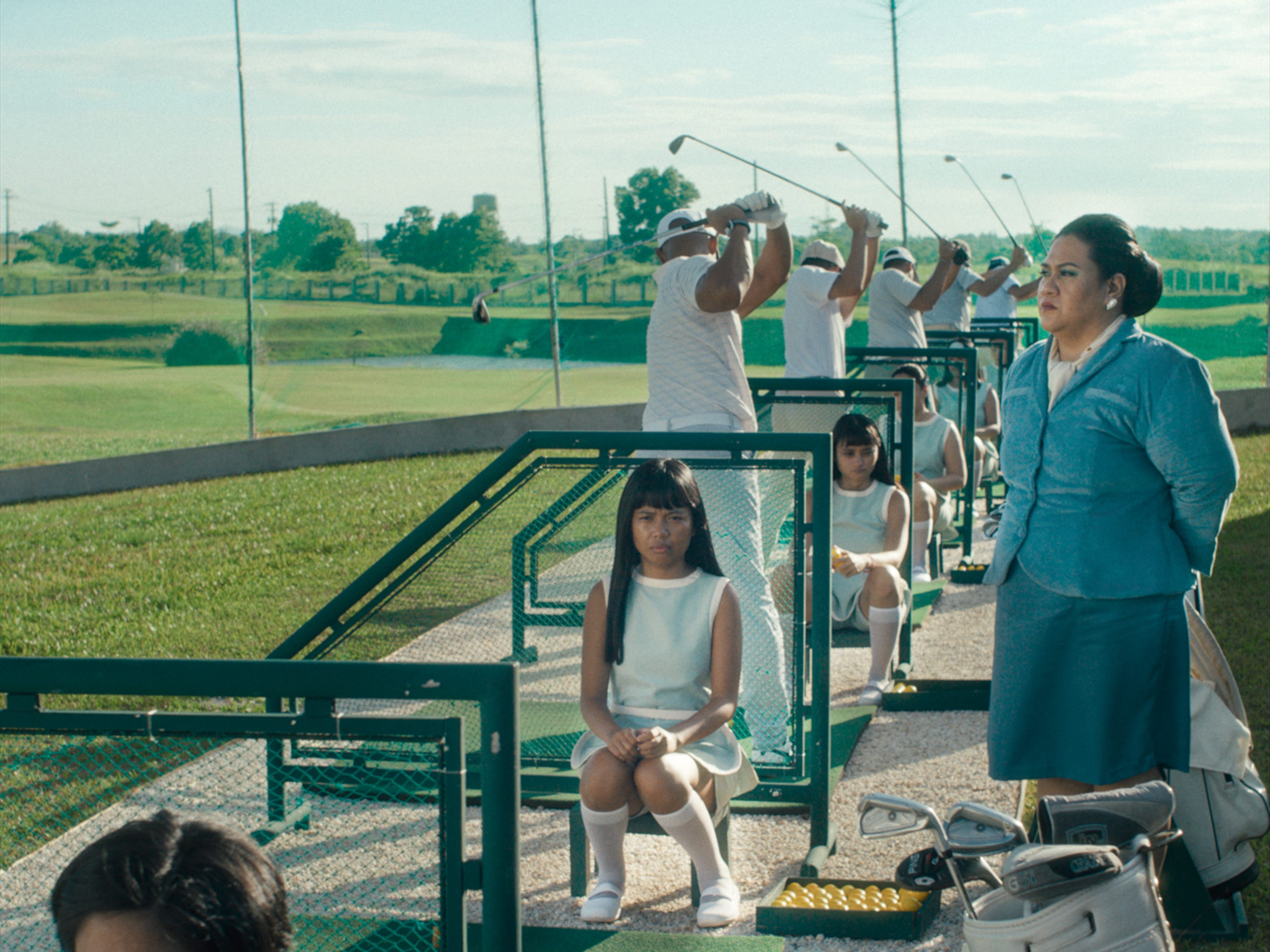
Beginning with the arrival of a van of tourists, the narrative then moves for its entirety to Alabang. The details of the staff’s duties are disturbing but never sensationalized. For example, Isabel (Jorrybell Agoto) learns that only golfers and caddies are allowed on the golf course and the workers cannot pick the mangos handing in plain view. As rows of golfers practice their swing, tee-girls, all in nondescript matching uniforms, sit below each golfer dutifully placing balls on the tee. Isabel fears an errant swing might result in her being hit by the ball. Another tee-girl reassures her that it’s not so bad. Other scenes include washing dozens of golf balls and placing them in trays, watching the numerous Chinese men who refuse to use tee-girls, dancing for and with guests, and, when they have an afternoon break, lying like sardines side by side for a rest. When a large fir tree dies because of the heat and drought, Isabel learns they just replace it with another. Meantime, hyperactive singing and dancing interludes belie the reality of the workers’ lives, purely performative for the paying guests’ amusement.
In a parallel subplot, wealthy Uncle Renato (Carlitos Siguion-Reyna) repeatedly urges his niece Clara (Carmen Castellanos) to leave New York to run his Golf Depot equipment business. She demurs as he insistently presses his case. Meantime, Isabel is tasked with returning an abandoned golf club to the indifferent president Dr. Palanca (Teroy Guzman) dining with his condescending wife. In a discreet act of rebellion Isabel explores the cavernous offices, carpeted wide stairways, reception rooms, black-and-white photo exhibit of historical images, heavenly blue pool, and a locker area where she overhears two guests insult “farmers always wanting more” as they scheme to develop nearby, valuable countryside. Most tragically, a young girl goes missing with few concerned except Isabel.
Several comments single out Isabel’s home in the norther Philippines region Ilokano, significantly also dictator Ferdinand Marcos’ birthplace. In a press notes interview, director Manuel notes there are “about 30-40 golf courses in and around Manila. Emphatically, he adds, “A golf course is the perfect metaphor for my country—in that it’s a very large and fertile plot of land that’s toiled and worked on my so many people, but ultimately, enjoyed and profited from by only a privileged few.” Equally insightful, Manuel continues, “You don’t need to be a murderer or a criminal to be complicit in structural violence.” Even sound effects communicate implicit violence, for Manuel knows that when a golf club hits a ball, “if you bring that sound up by three or six decibels, it sounds like a gunshot.” Additionally communicating his condemnation of hierarchical exploitation, cinematographer Xenia Patricia’s revealing compositions frame club members “very high in the frame, while the workers are shown very low, looking up” in a vertical 4:3 aspect ratio. Set in the Philippines, ”Filipiñana” resonates with denunciation of global parallels. The Philippines’ official submission for this year’s Academy Award for Best International Film, in Filipino, Ilokano, and English with English subtitles, “Filipiñana” will screen at Webster University’s Winifred Moore auditorium Friday, September 18, through Sunday, September 20, at 7:30 p.m. each of those evenings. For more information, visit the film series website