

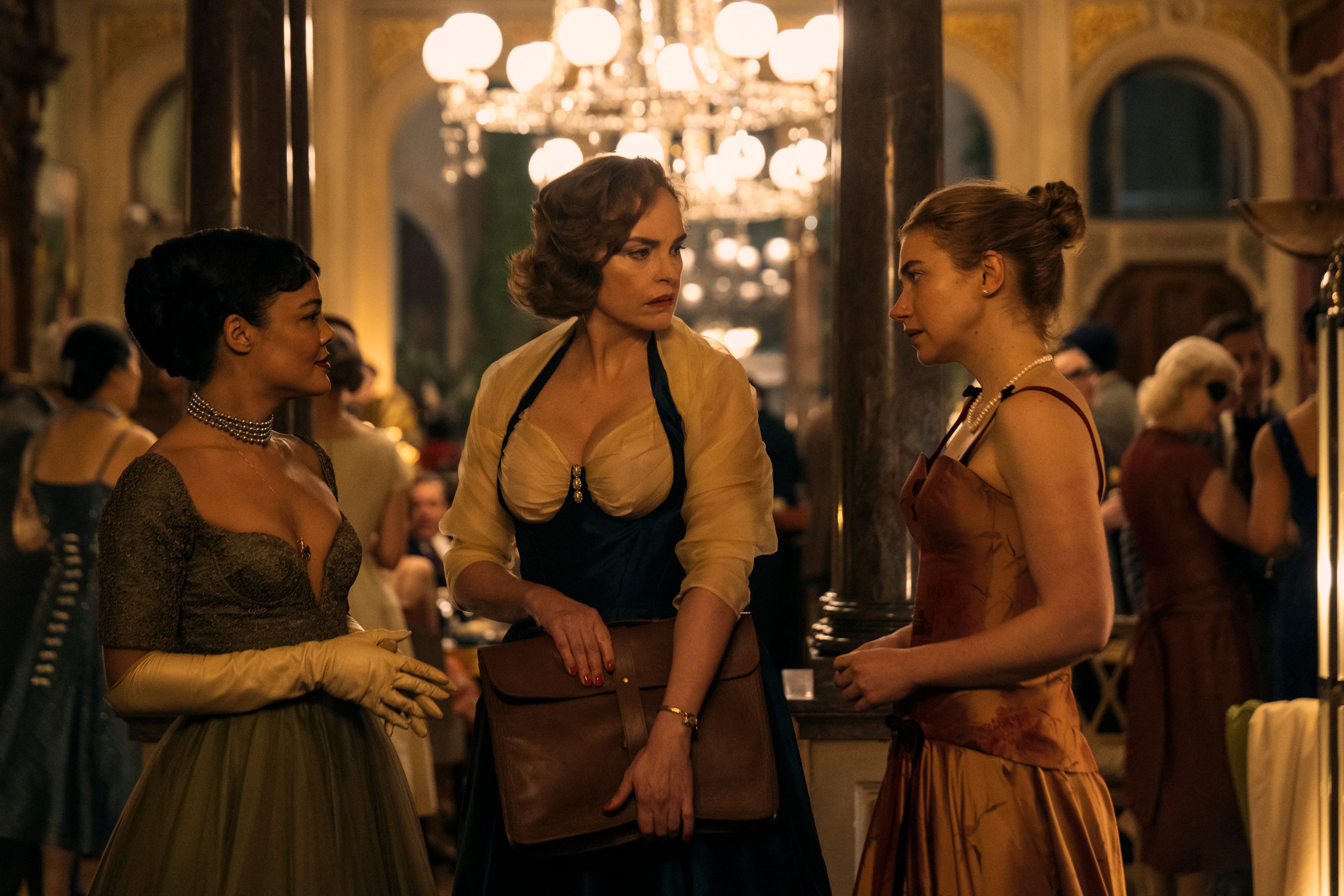
In “Hedda,” writer/director Nia DaCosta undertakes the daunting challenge of radically reimagining Norwegian Henrik Ibsen’s iconic play of Hedda Gabler’s restrictive, resented life in 19th century Norway. Surreptitiously rebellious amidst cultural frustration, Ibsen’s Hedda resents societal and monetary constraints which she deviously counters with abhorrent actions. Originally staged 31 January 1891 at Munich’s Residenztheater with Ibsen backstage, theatrical and film adaptations and reinterpretations have proliferated. None have been as inspired as DaCosta’s, for Hedda (Tessa Thompson) becomes a Black woman and Ejlert Lövborg becomes Eileen (Nina Hoss), thereby doubly altering the power dynamics through racial and sexual transformations.
Set now in 1950s England, an essential conflict remains the advancement of Hedda’s husband George Tesman (Tom Bateman) to full professor, though it is abundantly clear that Eileen’s manuscript outshines anything George has authored or is capable of authoring. For that pioneering manuscript’s revolutionary theory redefines sexual desire and, in its orbit, powerful female agency. Adding further complications, Thea Elvsted (Imogen Poots), who has left her husband as Eileen’s devoted lover, attends the increasingly raucous evening, one described by LaCosta in press notes as “funny, emotional, and messy.” Also on hand is Judge Brack (Nicholas Pinnock), Hedda’s long-time friend and confidant who holds sway over Hedda for his having financed her extravagant home. But at its heart, three women dominate: Hedda, Eileen, and Thea, each striving to assert their defiant individuality in a repressive environment of intractable limitations. Hedda and Eileen, once lovers, now square off in verbal combat and, on Hedda’s part, underhanded betrayal of heinous proportions.
At a virtual press conference I attended for “Hedda,” director Da Costa zeroed in on Hedda wanting to live the life she envisioned, wanting to feel in control of her immediate environment. She described all the characters wanting “to provoke the world to find their places in it.” Tessa Thompson, who plays Hedda, found DaCosta’s changes made the questions more existential, wondering “how much are we trapped by society’s expectations or our own limiting thoughts?” Thompson said we “like to think we live in a time very free but often feel trapped,” making this “Hedda” very relevant. Da Costa elaborated, “Every story about power or love or sex or being a high-powered woman is always about what it is to be human and putting your ego aside.” As important, in rapport with the film, she knows “we don’t need to see people exactly like us to connect with them.”
Technically, “Hedda” uses costumes, music, and art direction to intensify the tension amidst increasingly dangerous conflict. In press notes, costume designer Lindsay Pugh and assistant costume designer Anna Reynolds describe the purposeful contrasts between the men’s buttoned-down dark suits (only Judge Brack escapes this constraint) and Hedda’s sultry green dress with a plunging neckline as well as Eileen’s show stopping party dress. Through Icelandic Hildur Guðnadóttir’s illuminating interpretation, music connects past and present, including a Bjork song originally from the 50s, the time the film is set. In a score dominated by wood, glass, and drums, Guðnadóttir explains that “percussion is Heda’s element.” She adds, “It closely echoes the clockwork of her overthinking mind and the mechanics of her constant plotting.” Editor Jacob Secher Schulsinger keeps that scheming moving juxtaposed with suspenseful pauses, and Cara Brower’s production design encases the characters in dark interiors and exteriors, metaphorically communicating this world. As DaCosta accurately explains, “I always saw the movie as a freight train that slowly leaves the station and keeps going faster and faster until it comes completely off the rails.” It’s a joy to enjoy the wild, instructive ride. “Hedda” is streaming on Prime Media.