

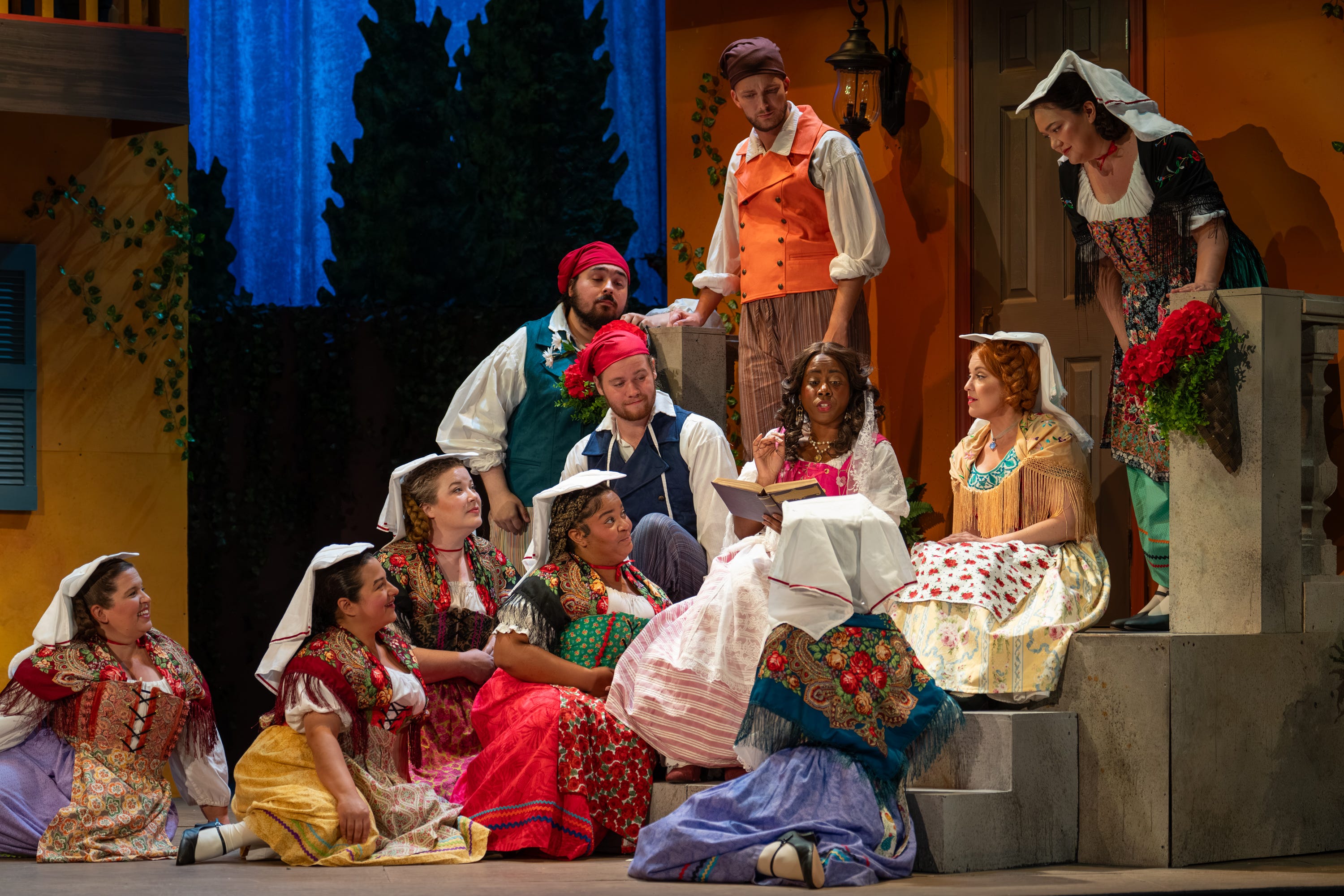
I can sum up Union Avenue Opera’s new production (their last one was in 2008) of Donizetti’s 1832 romantic comedy L’elisir d’amore (The Elixir of Love) in one phrase: Bravi tutti. Every single aspect of this funny, endearing, and beautifully sung show deserves heaps of praise. The cast is simply perfection, with all five named roles filled by fantastic comic actors with stunning voices, each one of whom is completely invested in their role.
Really, I could stop here, and you’d already know all you need to know about why you should grab tickets now for one of the remaining performances at 8 pm Friday and Saturday, July 31 and August 1. But first I’d like to take a step back and look at the opera itself.
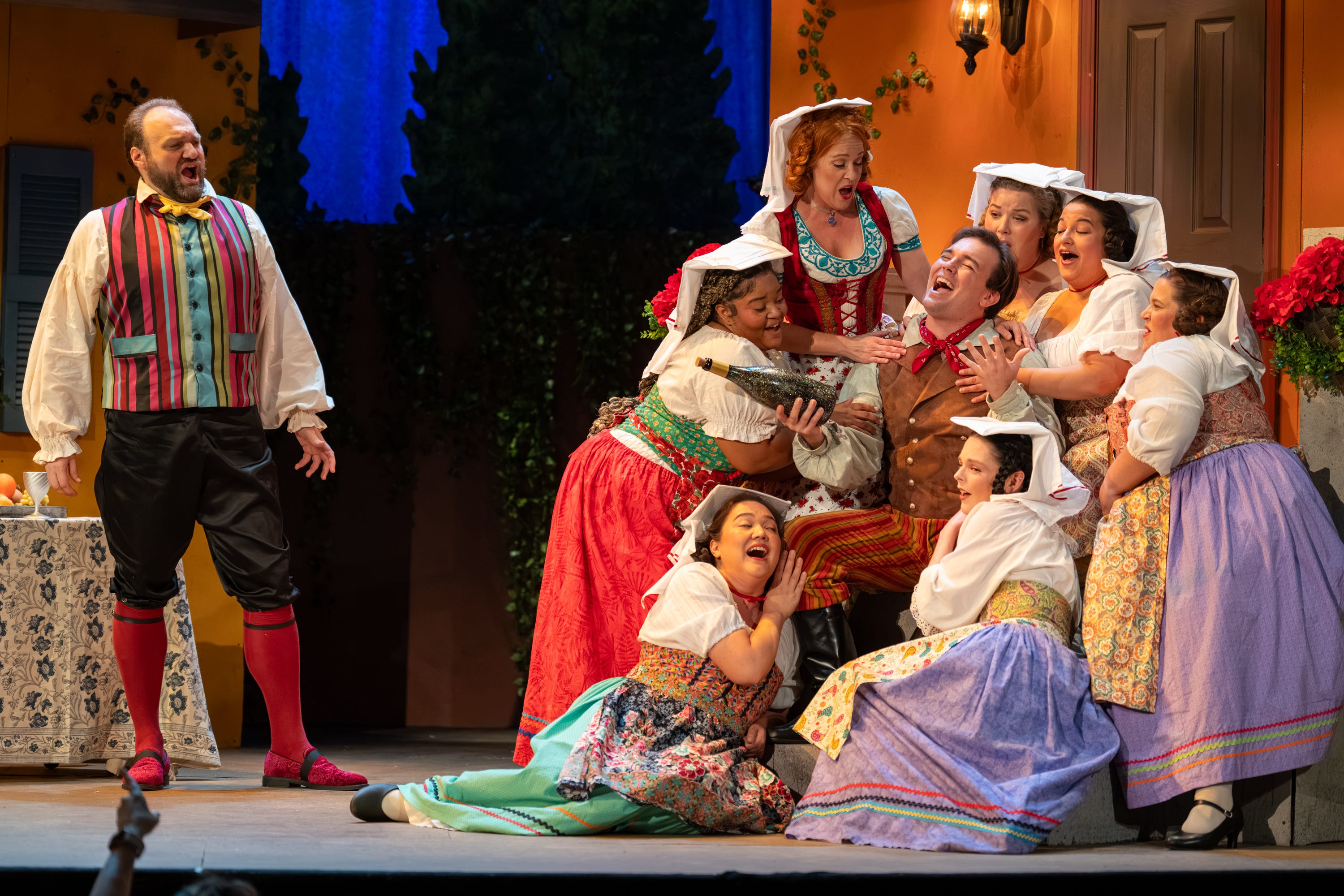
Are you disgusted with the way your Facebook friends are cheerfully spreading bogus news items without bothering to fact check them? Convinced that the Internet is turning us into a nation of credulous chumps who will buy and/or believe anything? As L’elisir d’amore demonstrates, P.T. Barnum’s observation about a sucker being born every minute is nothing new.
Based on Eugène Scribe’s libretto for Daniel Auber’s popular opéra comique Le philtre from 1831, Felice Romani’s book for “The Elixir of Love” is the story of Nemorino, a humble peasant smitten with the wealthy, beautiful, and well-educated landowner Adina. Alas, the difference in their positions in society and Nemorino’s own shyness have combined to make it impossible for him to declare his feelings.
Adina is nevertheless sharp enough to have divined Nemorino feelings and, since she secretly shares them, is frustrated at his reluctance to be open with her. When the macho, self-admiring Sergeant Belcore struts into town on a recruiting mission Adina, in an attempt to spark Nemorino into action, pretends to be attracted to Belcore despite being put off by his egomania.
In desperation, Nemorino buys a love potion (actually just some cheap wine) from the traveling quack Dr. Dulcamara. In classic romcom fashion, complications ensue.
Two and one-half hours and much singing later, all ends happily for everyone except Belcore. That includes Dr. Dulcamara who, as the curtain descends, is still fleecing the suckers.
The opera proved to be a huge hit for Donizetti and is still one of his most popular works, outpacing even his popular tragedy, Lucia di Lammermoor. That’s partly because, as the late British opera scholar Julian Budden wrote in History of Opera (Norton/Grove, 1989, ed. by Stanley Sadie), “Donizetti created a pastoral comedy that fulfills the Romantic ideals of its day” and partly because the story of the gullible rube being taken in by the sharp con artist was as much of a comic gold mine nearly two centuries ago as it is now.
I leave the determination of any possible resonance with current affairs to the reader.
Even so, the opera’s immediate success was a bit of a surprise. Donizetti—who had a reputation for being able to crank out operas under a deadline—had to brew his “Elixir” in just over a month in April of 1832 when a previously contracted work for Milan’s Teatro alla Canobbiana (now the Teatro Lirico Giogio Gober) failed to materialize. The opera was still being revised up to around ten days before the May 12 premiere.
In addition, Le philtre was still running at the Théâtre de l’Opéra in Paris and was considered as a better work for most of the 19th century. History, however, has spoken. Today L’elisir remains firmly in the repertoire of most opera companies and Philtre is little more than a footnote.
Maybe that’s because, as my fellow critic Benjamin Torbert has said, L’elisir d’amore is a “bulletproof” opera—a sure-fire hit, if you will. If so, the Union Avenue production is not just bulletproof but downright invulnerable. There is nary a false step anywhere, beginning, as noted above, with the cast.
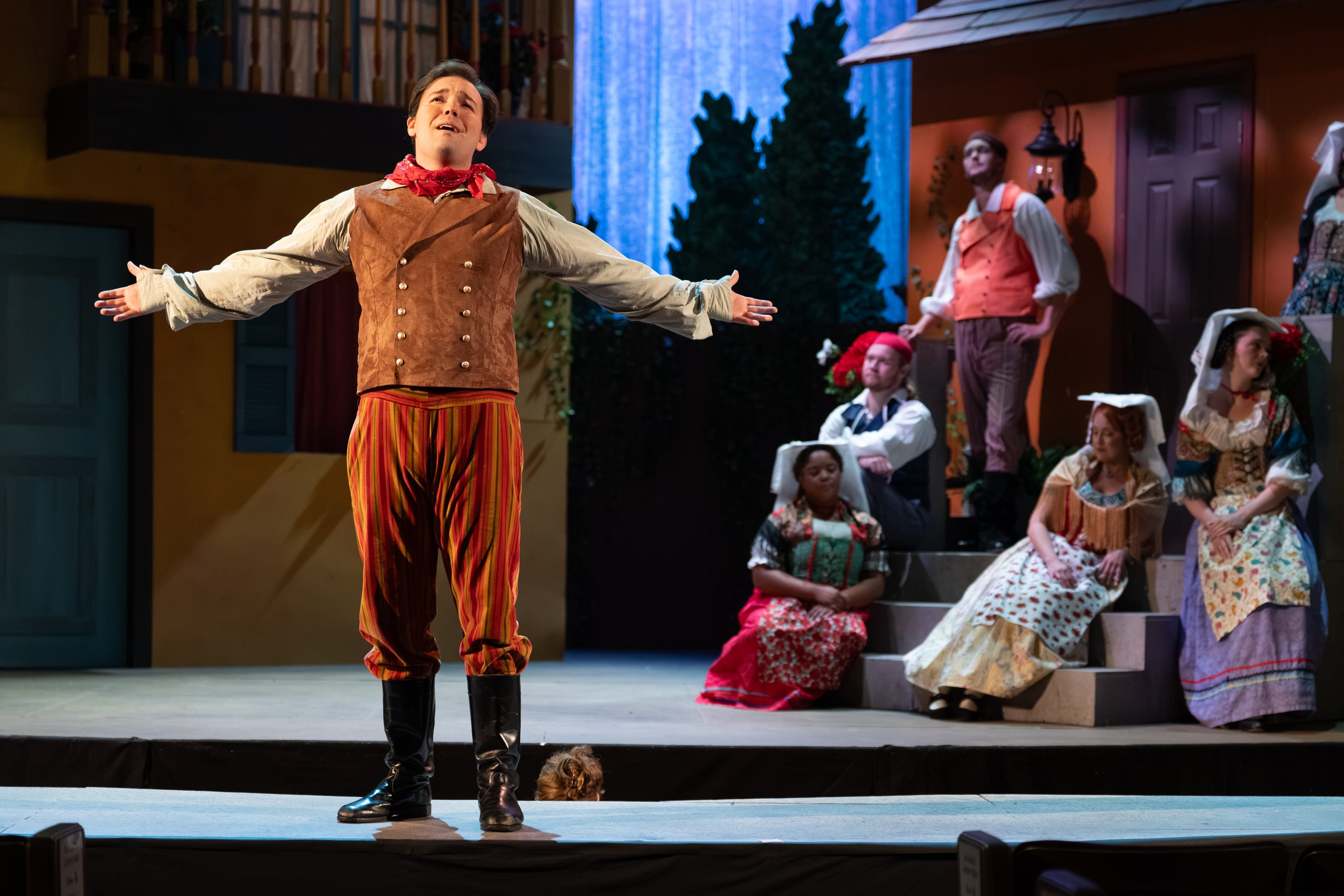
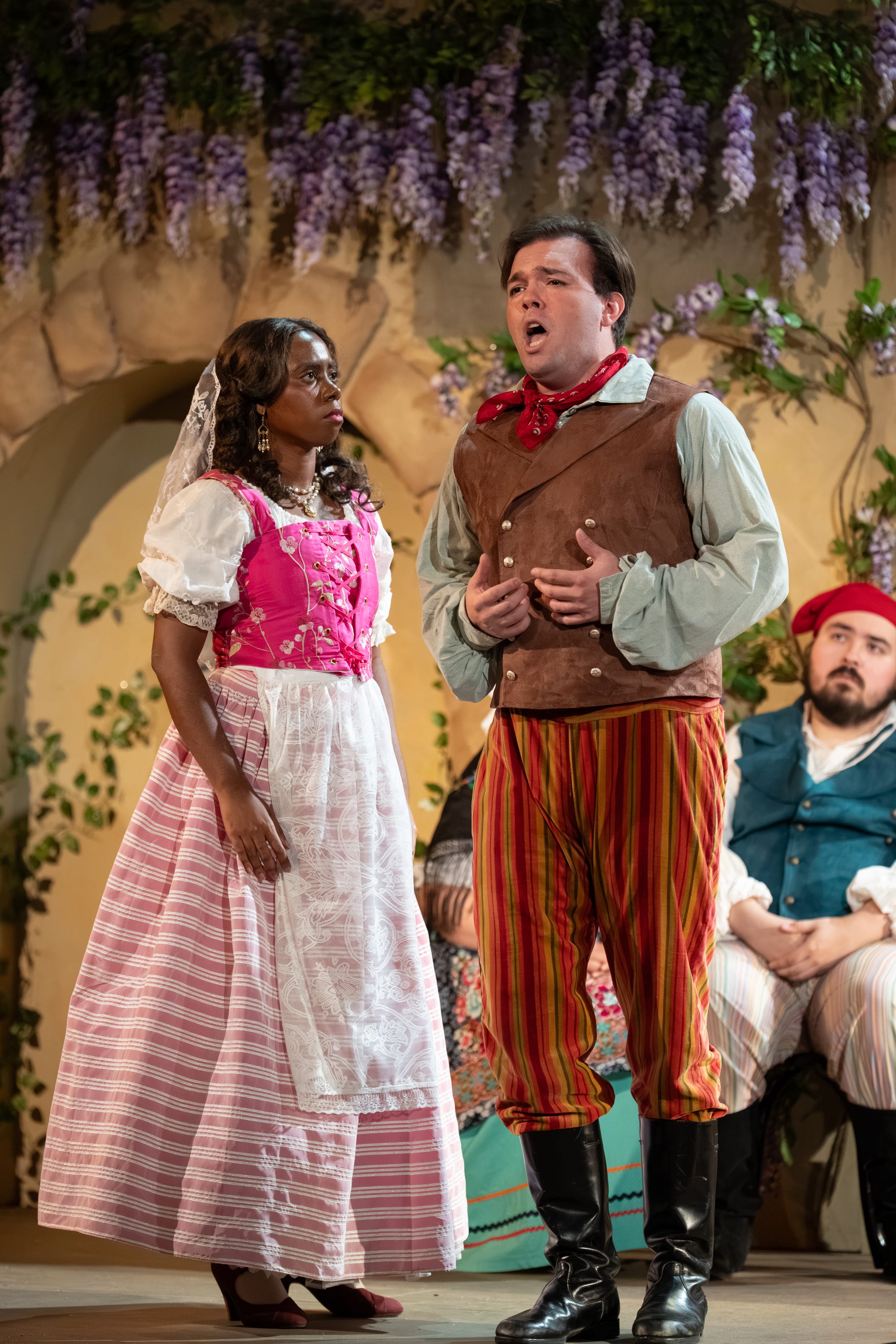
As Nemorino, tenor Charles Calotta (one of only two UAO veterans in the cast) is a besieged but loveable Everyman, bullied about by the smug Belcore and treated with benign disdain by Adina. He makes the character’s shyness almost painful to behold. How can you not root for this guy?
It doesn’t hurt, of course that Calotta has a big, impressive voice that can also be wistfully sad. His performance of the famous Act II aria of despair, “Una furtiva lagrima” (“A furtive tear”), deserved all the shouts of “bravo” that followed it.
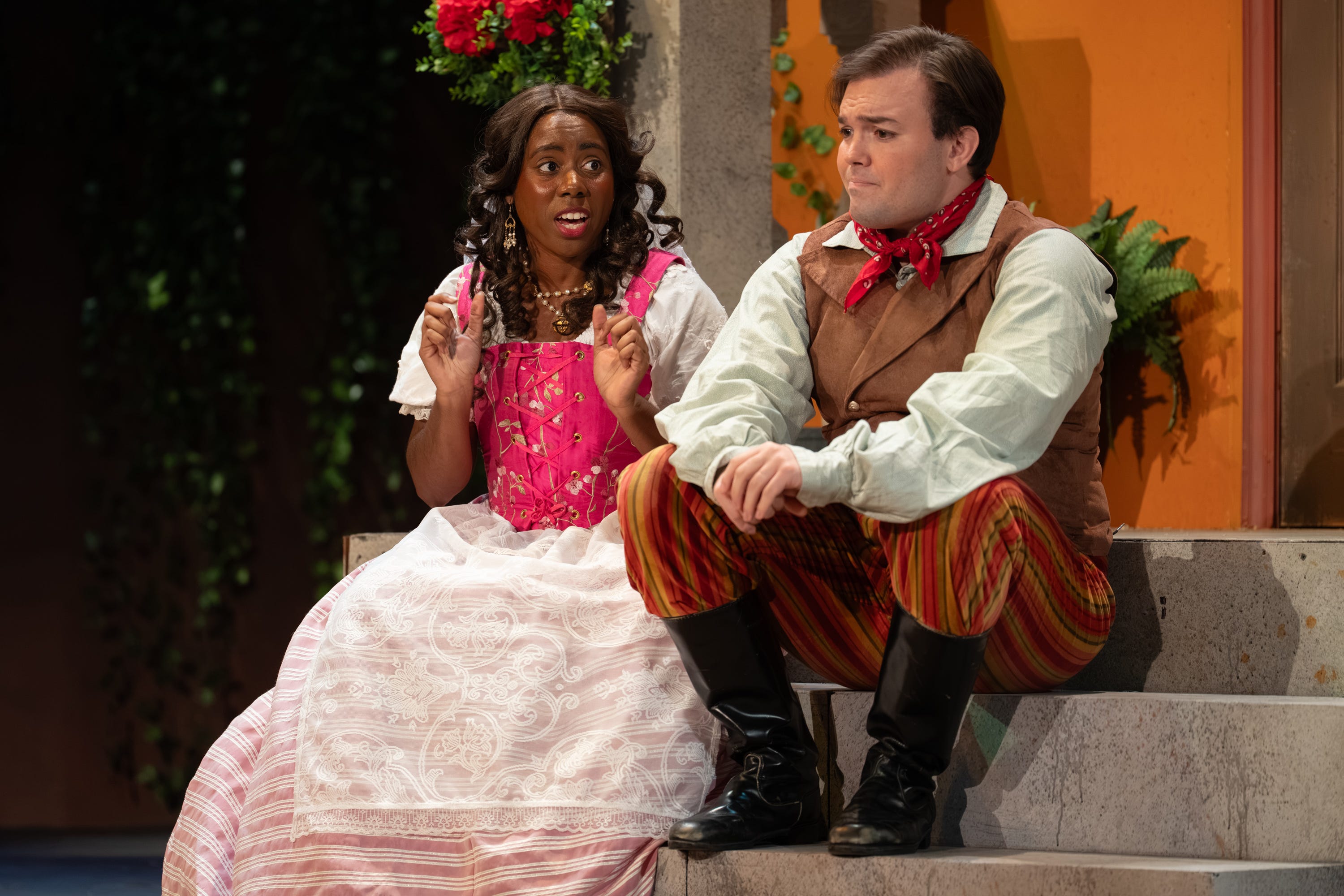
As Adina, soprano Kyaunnee Richardson is so credibly haughty and self-assured that it’s easy to see why Nemorino regards her as unattainable. She’s also just as thoroughly invested in the character’s more tender moments, though, and has the kind of fluid, flexible voice that can handle the many bel canto moments with ease.
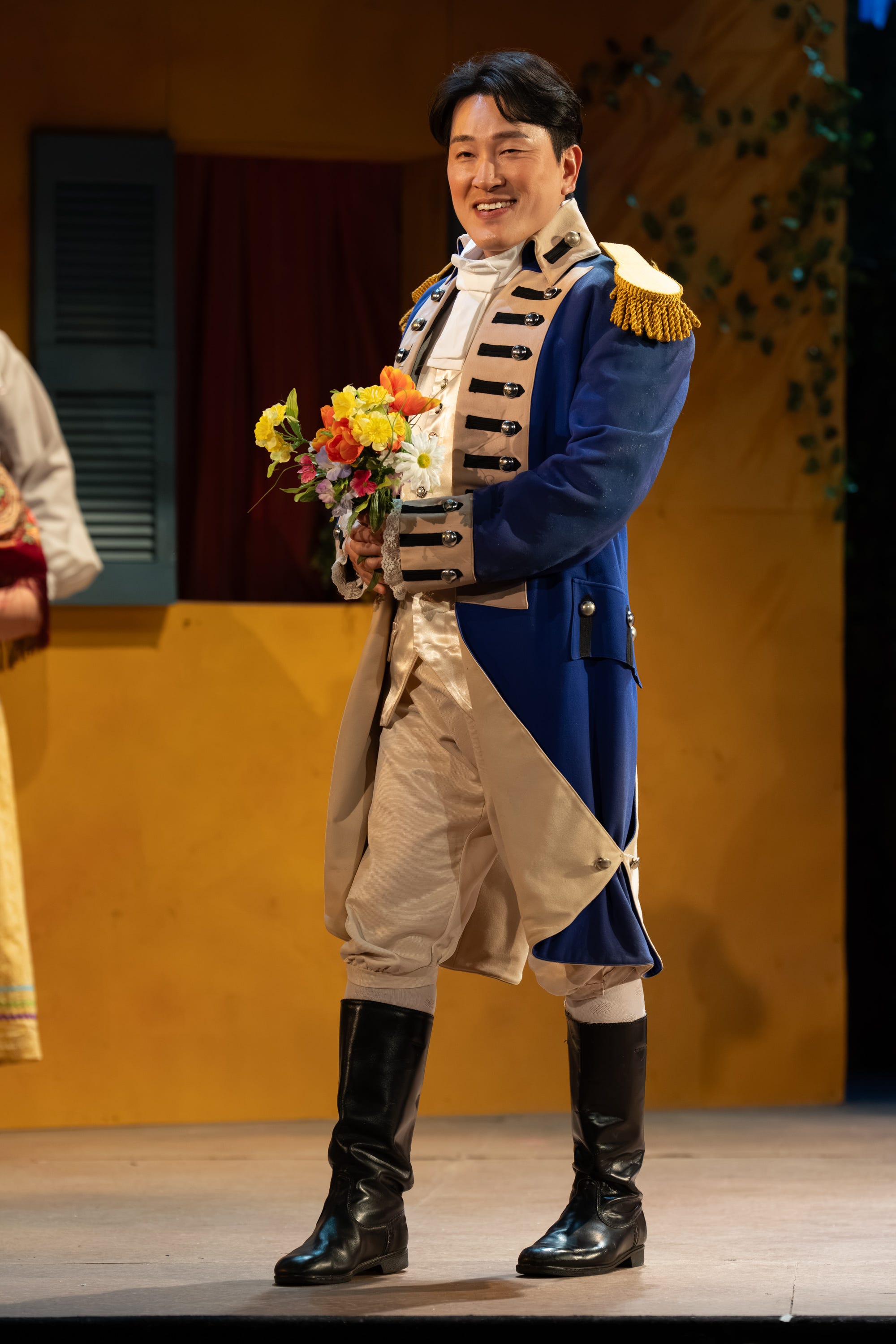
Baritone Junhan Choi is a perfectly pompous Belcore—the classic swaggering fool who is taken seriously only by himself. The absurdly Napoleonic costume Teresa Dogget has given him is just icing on the cake. His voice is as outsized is his character, making his first big number “Come Paride vezzoso” (“Like the dashing Paris”), in which he modestly compares himself to the legendary Trojan prince, a comic hit.
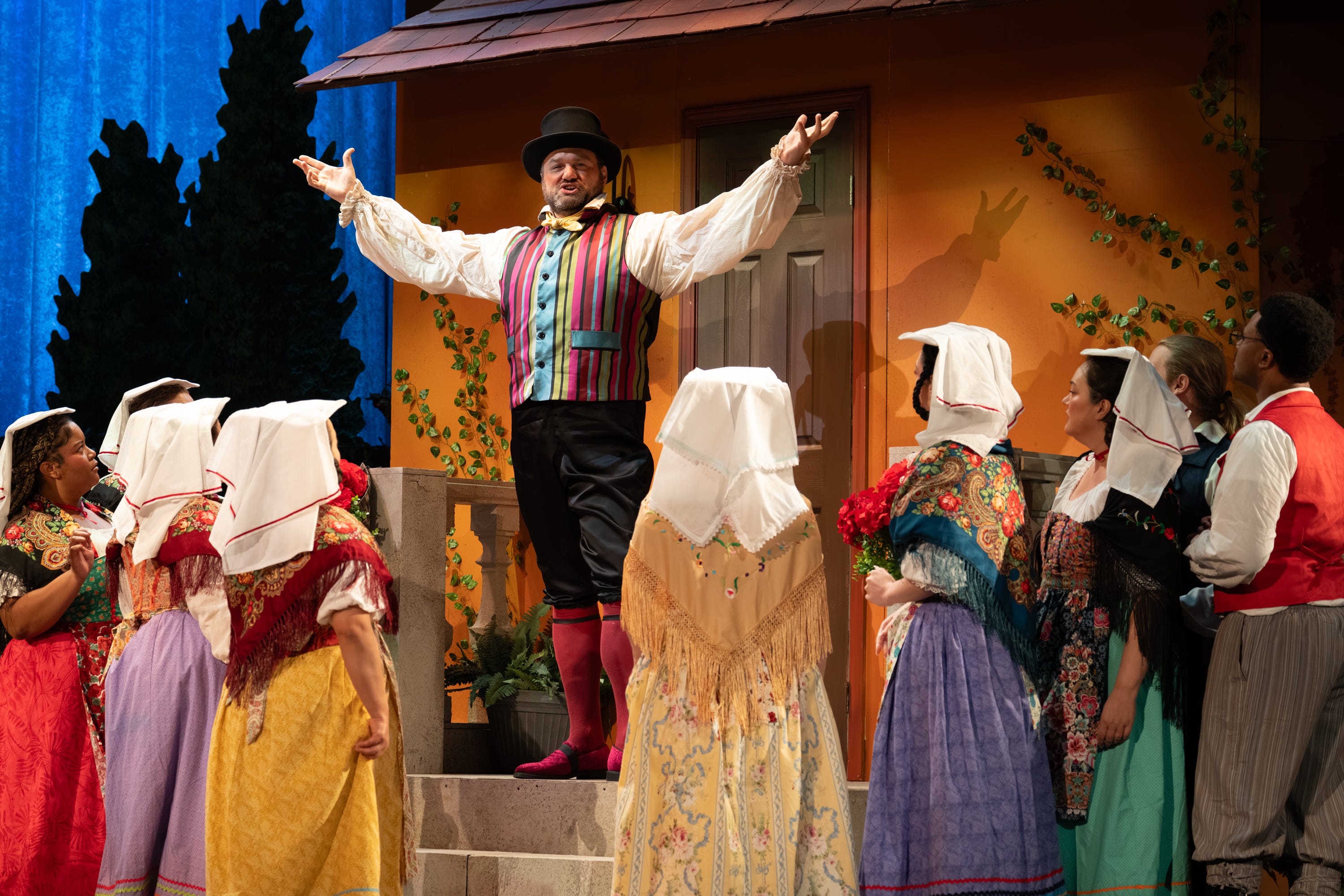
Speaking of comic hits, bass-baritone John Robert Green brings the right mix of swagger and charm to the role of the traveling quack Dr. Dulcamara, selling his “Mirabile liquore”—guaranteed to cure everything from toothache to old age. Dulcamara’s sales pitch, “Udite, udite, o rustici” (“Listen, listen you rustics”), is a classic patter song, filled with complex rhymes and rhetorical exaggeration, and Green does it with precision and power.
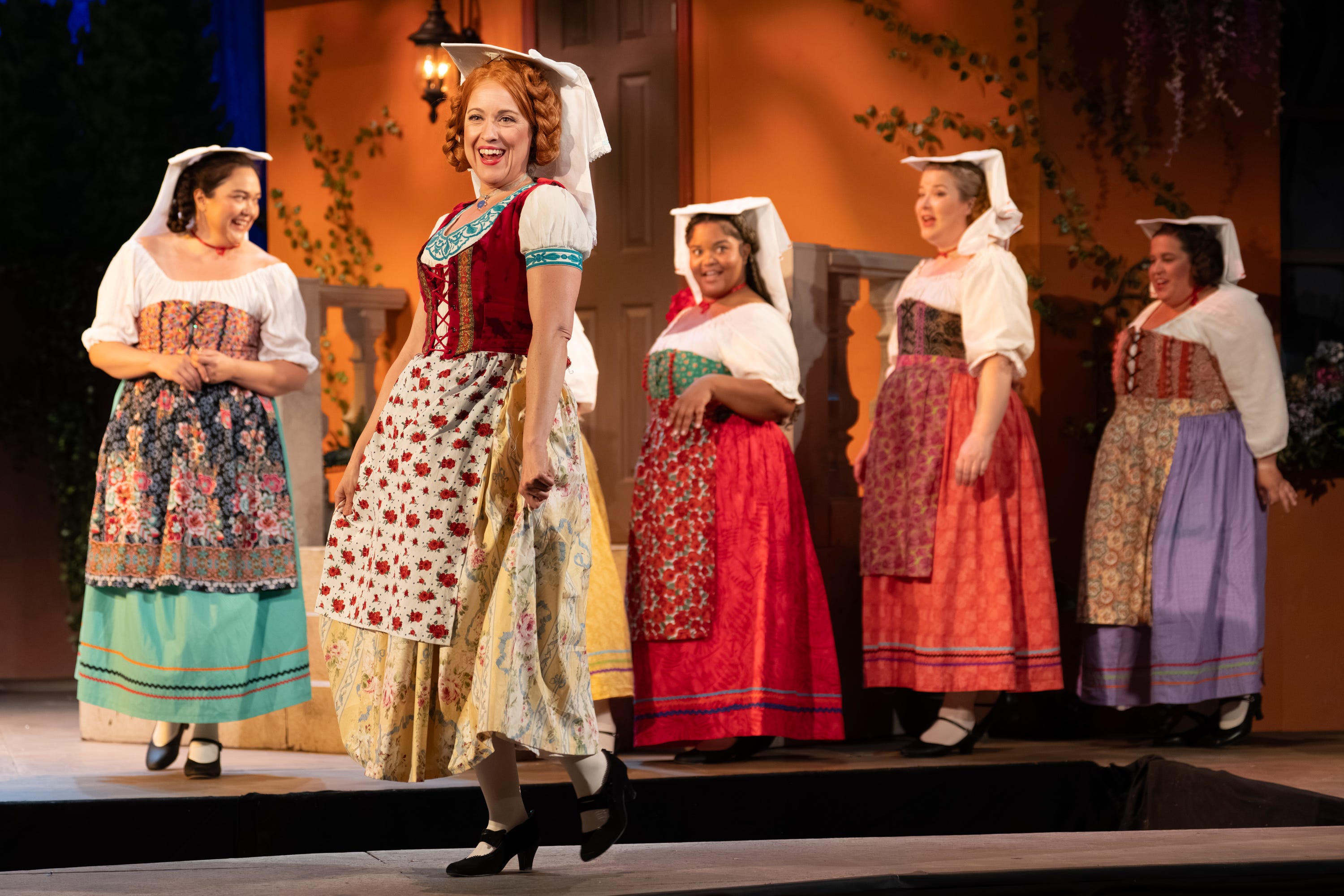
Rounding out this remarkable assemblage of talent is soprano Leann Schuering as Adina’s bestie Giannetta. It’s a small part, featured only in “Seria, possible?” (“Could it be possible?”), the number in which we learn that Nemorino is no longer impoverished, but it calls for a coquettish delivery and a light, lilting voice. Schuering whose work has distinguished many local productions is, if anything, overqualified for the part. But then, one of the hallmarks of a fine production is the presence of top-notch performers in even the smallest parts.
And this is certainly a top-notch production. Union Avenue’s chorus and orchestra are in fine form as usual, with a sprightly rendition of Donizetti’s earwormy score under Cara Chowning, with a little extra tip of the hat for bassoonist Donita Bauer and harpist Megan Stout in “Una furtive lagrima” Jon Truitt’s zippy and visually striking direction occasionally overdoes the slapstick, but not enough to be an issue. Laura Skroska’s bucolic early 19th-century set is appropriately bright, as are Teresa Doggett’s costumes.
This is the third L’elisir d’amore I’ve seen locally and far and away the best. Go to Union Avenue’s web site, get your tickets, laugh, and enjoy. It’s just the right miracle cure for this summer of our discontent. Performances are in Italian with English supertitles and run around two and one-half hours, including intermission.
You captured it to a T.
Only Chuck Lavazzi can make me want to see an opera performance. Thank you!